
Curious how TeamOhana can help you? Talk to us.
In this article
Never miss new content
Someone gives notice and the manager submits a backfill. A year ago it would have been approved by default. Now the request comes back with a question: can AI do this job?
It is the right question, and almost nobody can answer it with numbers. The hire has a price: salary, benefits, recruiting time. The AI alternative usually does not. This article shares how People and Finance teams can price the three real options for any open role, and what to put on the headcount request so the decision is made on cost and evidence instead of opinion.
Key takeaways
- Headcount requests increasingly have to show why AI cannot do the work. Leapsome's research found 53% of HR leaders have chosen not to backfill some roles because of AI.
- The decision stalls because the hire has a price and the AI option does not.
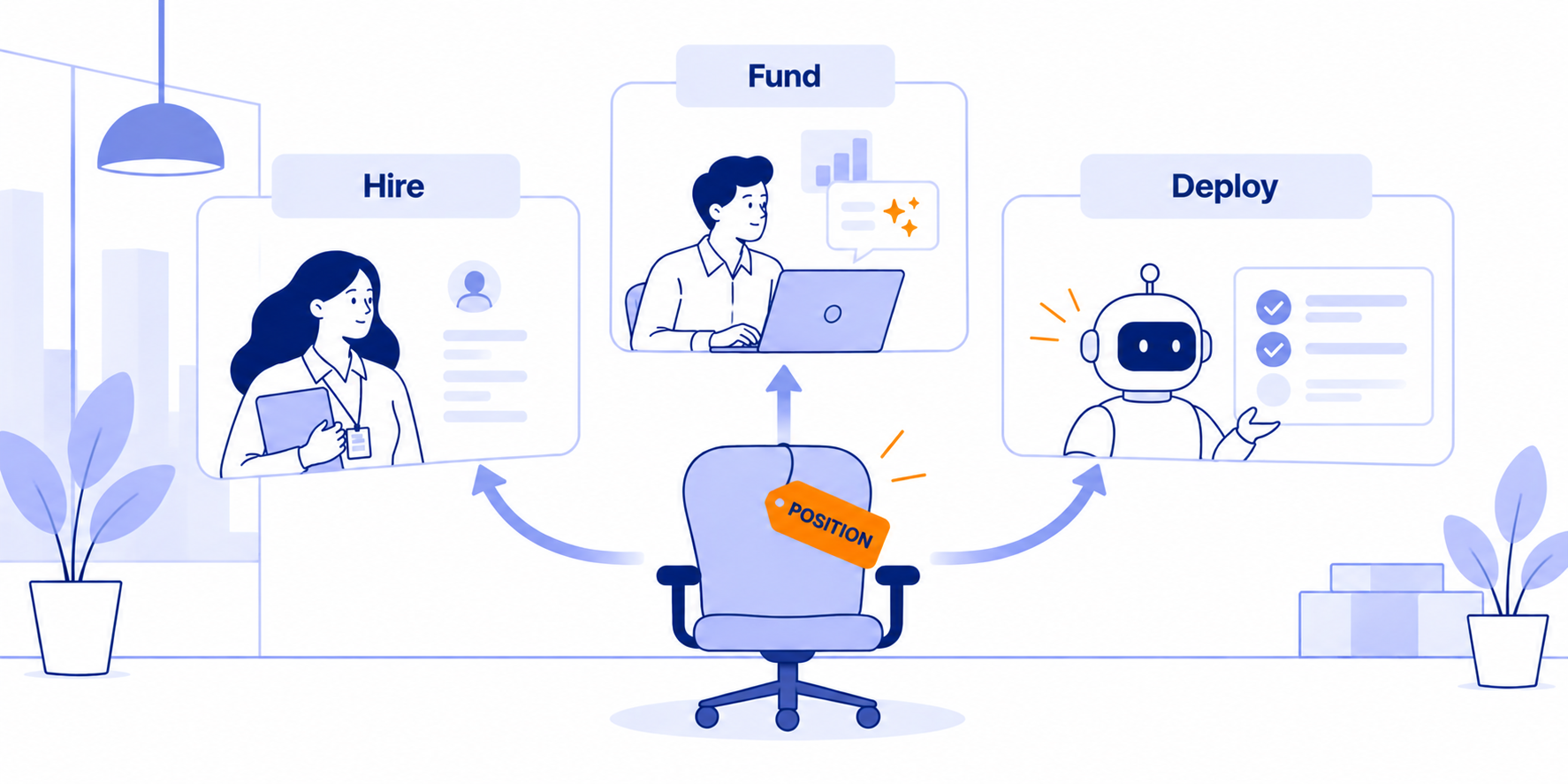
- Every open role has three options: hire a person, fund more AI for the existing team, or deploy a digital co-worker.
- Each option can be priced from the same inputs: fully loaded comp, the team's AI spend baseline and the run cost of any automated work.
- A backfill request should state the expected AI spend for the role and the evidence from the current team.
Why is every backfill now an AI question?
Leaders are asking AI questions about headcount because AI spend now comes out of the same budget. When a company spends real money on AI, every new role has to justify itself against that spend.
Shopify made this public in 2025, when its CEO told teams to show why AI could not do the work before asking for more headcount. Most companies we talk to have written something similar into their own process. A Talent leader at a SaaS company described what changed on their headcount request form:
"Each leader has to kind of outline, like, what part of this job could AI potentially take over?"
The Head of Talent Acquisition at a travel technology company with more than 1,300 employees put the backfill version plainly:
"If you're doing a replacement, do we need to really do this replacement? Can AI take over this role?"
And a planning lead at a healthcare software company described the moment the question reaches Finance:
"We just invested a million dollars in AI... do we need that role still?"
Why can't teams answer it?
The hire has a price and the alternative does not. People and Finance can tell you what a role costs to the dollar. Almost nobody can tell you what the same work costs when AI does more of it, because AI spend is not tracked by role.
Engineering teams are furthest along, because that is where most of the spend sits. A headcount planning lead at an enterprise technology company told us engineering already makes the trade-off explicitly:
"How much can we afford in terms of tokens versus people?"
Outside engineering, the same company spreads AI budget evenly by level. That works for a rollout. It does not help a manager decide whether to backfill a support role or give the remaining team more AI.
The cost side is only half of it. A finance leader at a healthcare company named the other half:
"There's tracking the cost, but then there's tracking the benefit."
What are the three options for an open role?
Hire
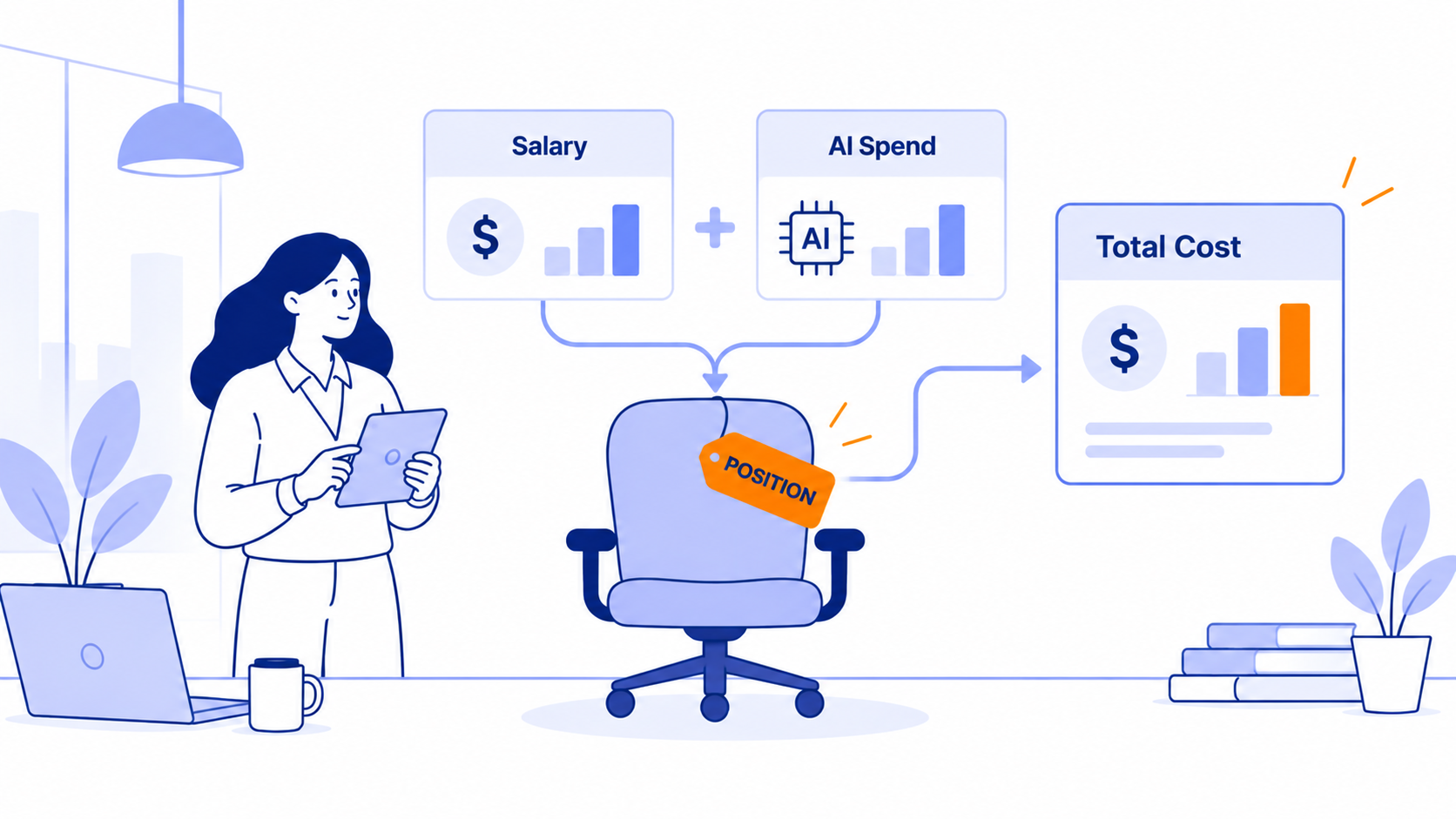
Fill the role with a person. Price it as fully loaded comp plus the AI spend the role will carry from day one, based on what similar roles on the team spend today. A new engineer adds payroll and AI spend. Both belong in the request.
Fund
Do not fill the role. Give the existing team more AI capacity instead. Price it as the increase in the team's AI spend over its baseline, and check it against evidence that the team can absorb the work.
Deploy
Move a defined piece of the work to a digital co-worker. Price it as the run cost of that work, plus the time of the person who owns and reviews it. Budget it as its own line, the same way you would budget a role.
A worked example
The numbers below are illustrative, not benchmarks. A support specialist on a team of six gives notice.
- Hire: $80,000 salary, about $100,000 fully loaded, plus $1,800 a year in AI spend based on the team's current baseline of $150 per person per month. About $101,800 a year.
- Fund: raise AI spend for the five remaining specialists by $300 a month each. $18,000 a year, if the team's ticket data shows it can absorb the volume.
- Deploy: a digital co-worker that resolves the most common ticket type, at an estimated $2,000 a month in run cost, plus 10% of a team lead's time to own and review it, about $10,000. About $34,000 a year.
The point is not that one option always wins. The point is that all three now have a price, from the same budget, so the decision can be made on cost and evidence.
What to add to your headcount request form
- Is this a backfill or net new?
- What share of the role's work could AI handle today, and what evidence does the current team's usage show?
- What AI spend comes with the role, based on similar roles on the team?
- If we fund AI instead, whose spend goes up, by how much, and how will we know it worked?
- If we deploy a digital co-worker, who owns it, and what does it cost to run?
When should you still hire?
Short answer: Often. AI is changing roles faster than it is removing them. The same Leapsome research found 77% of HR leaders say AI has created new roles in their organizations. Hire when the work depends on judgment, relationships or accountability that the team cannot cover, or when the team's AI usage data shows they are already at capacity. Pricing the alternatives makes a hire easier to approve, because the request shows the options were considered.
How TeamOhana helps
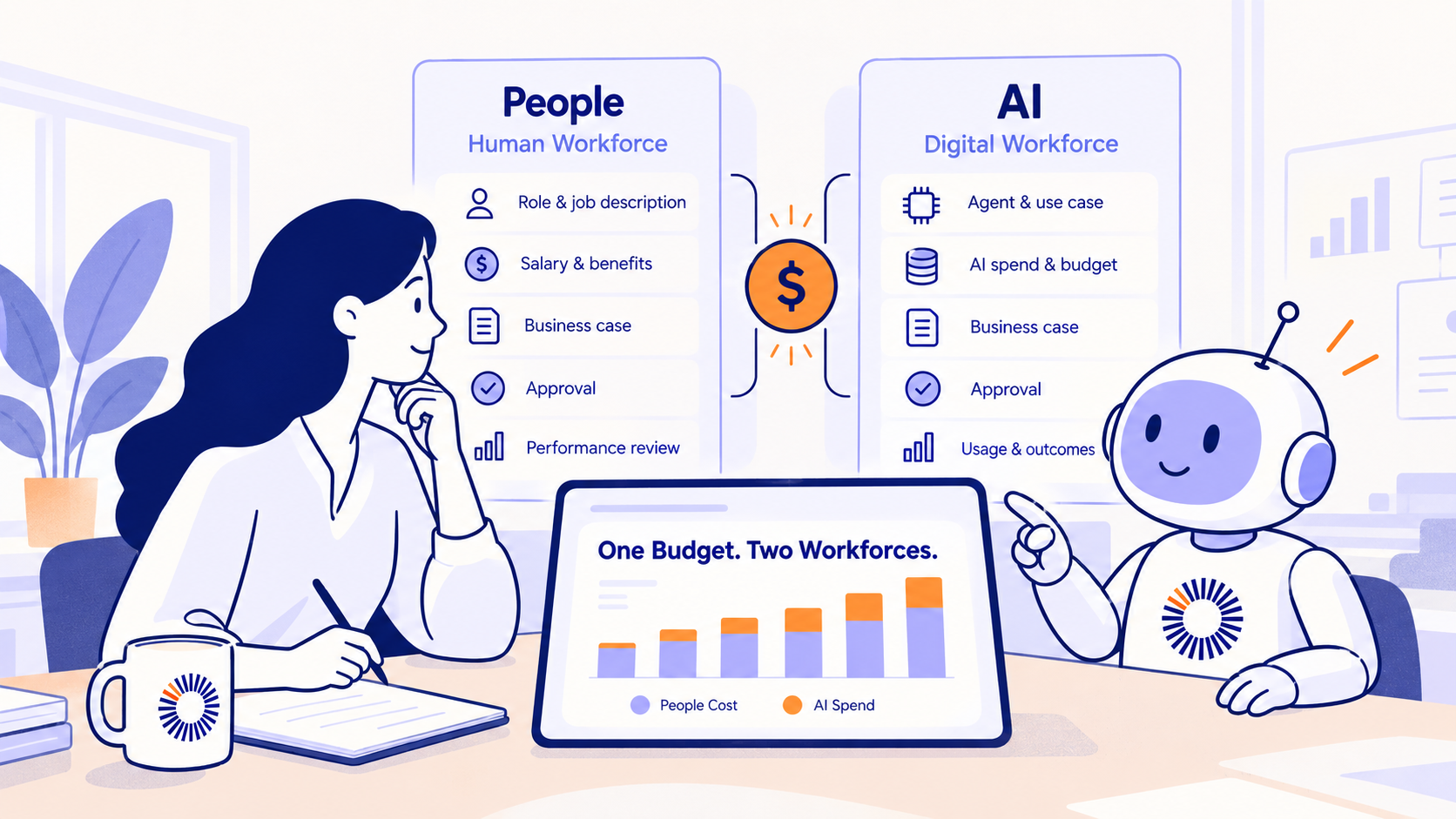
TeamOhana puts headcount and AI spend in one budget. Every planned hire is priced with comp and expected AI spend. Finance and People can compare hire, fund and deploy side by side, and every digital co-worker is budgeted with an owner like the rest of the workforce. Price hire, fund and deploy from one budget.
Related: Finance owns the budget. Engineering owns the keys. Who owns AI spend?, How to budget AI spend in your 2027 headcount plan and why AI spend belongs in the headcount plan.
Sources
- Leapsome, Headcount planning in 2026, leapsome.com/blog/headcount-planning
- Shopify CEO memo on AI and headcount (2025), as reported by eMarketer and HR Daily Advisor
- TeamOhana conversations with finance, People and Talent leaders, Aug to Oct 2026 (anonymized)
Take control of your headcount spend

Backfill or AI FAQs
Simplifying TeamOhana: your questions, answered.
Price both. Compare the fully loaded cost of the hire, including the AI spend the role will carry, with the cost of funding more AI for the team or deploying a digital co-worker for a defined part of the work. Then check the team's usage data for evidence it can absorb the work.
Show the three options with costs, the share of the work AI handles today based on the team's usage, and why the remaining work needs a person.
A digital co-worker is an AI system that does a defined piece of work with a named human owner. It is budgeted and tracked like a member of the workforce.
Not always. Many companies are adding roles because of AI. The question for each opening is which option gets the work done at the right cost.
Hire when the work depends on judgment, relationships or accountability the team cannot cover, or when the team's AI usage data shows it is already at capacity. Leapsome found 77% of HR leaders say AI has created new roles. Pricing the alternatives makes a hire easier to approve.