
Curious how TeamOhana can help you? Talk to us.
In this article
Never miss new content
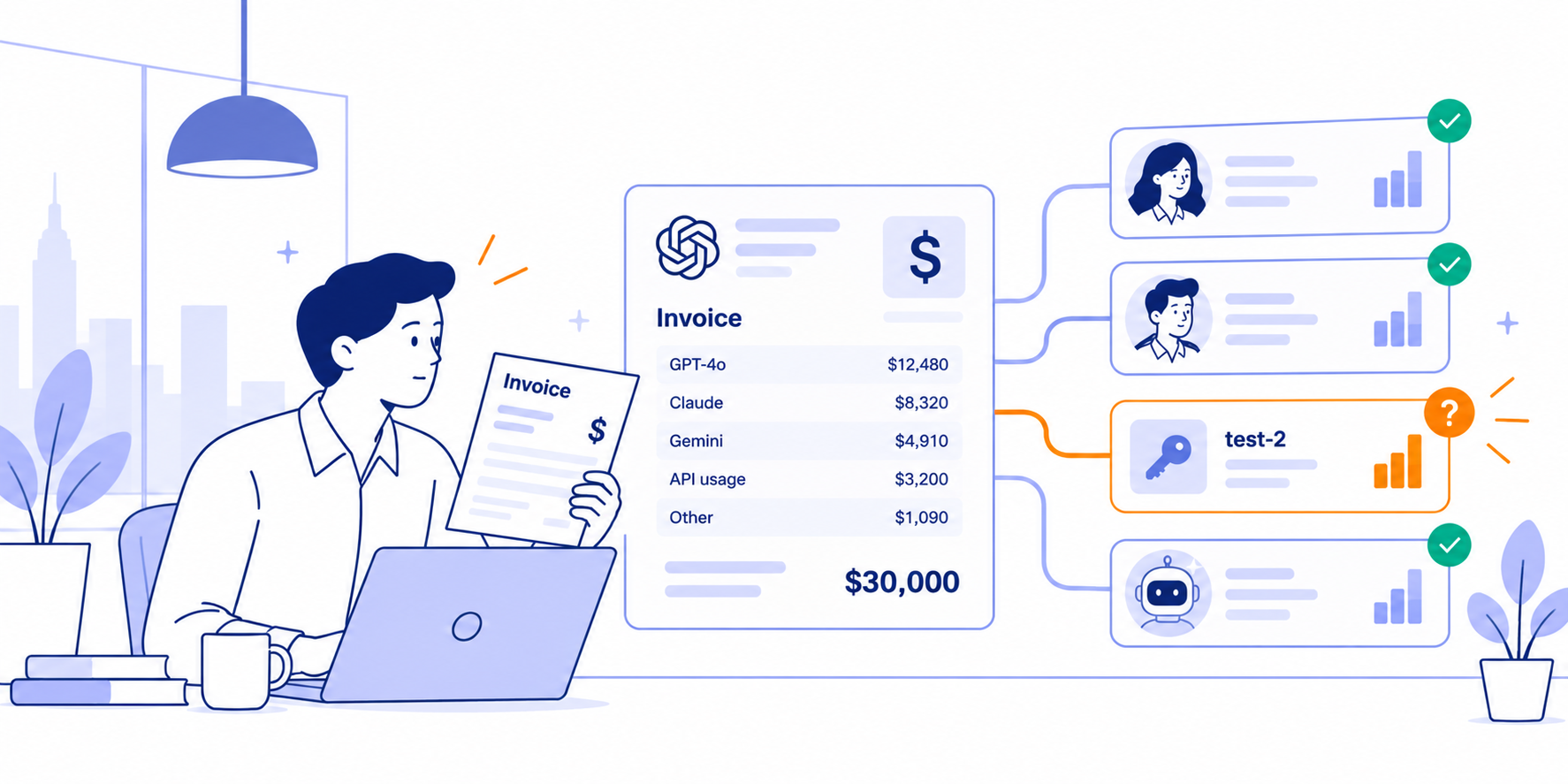
The AI bill arrives and it is bigger than the plan. Finance asks who spent it and nobody can say for sure. So the company does the obvious thing and sets a cap: a flat dollar amount per person per month, with overages approved by email.
That is where most of the companies we talk to are right now. Caps bring the total down. They don't tell you whether the spend was worth it, and they don't tell you where AI belongs in next year's plan. This article covers why AI spend runs over budget, where caps fall short, and what to measure instead.
Key takeaways
- AI spend runs over budget because most AI tools bill by usage, and usage changes by person, model and week.
- In SpendHound's 2026 survey of 172 finance and procurement leaders, 46% said they exceeded their AI budget in 2025.
- Per-person caps control the total. They treat a heavy user doing valuable work the same as one burning tokens.
- The useful comparison is a person's spend against their team's baseline, not against a company-wide total.
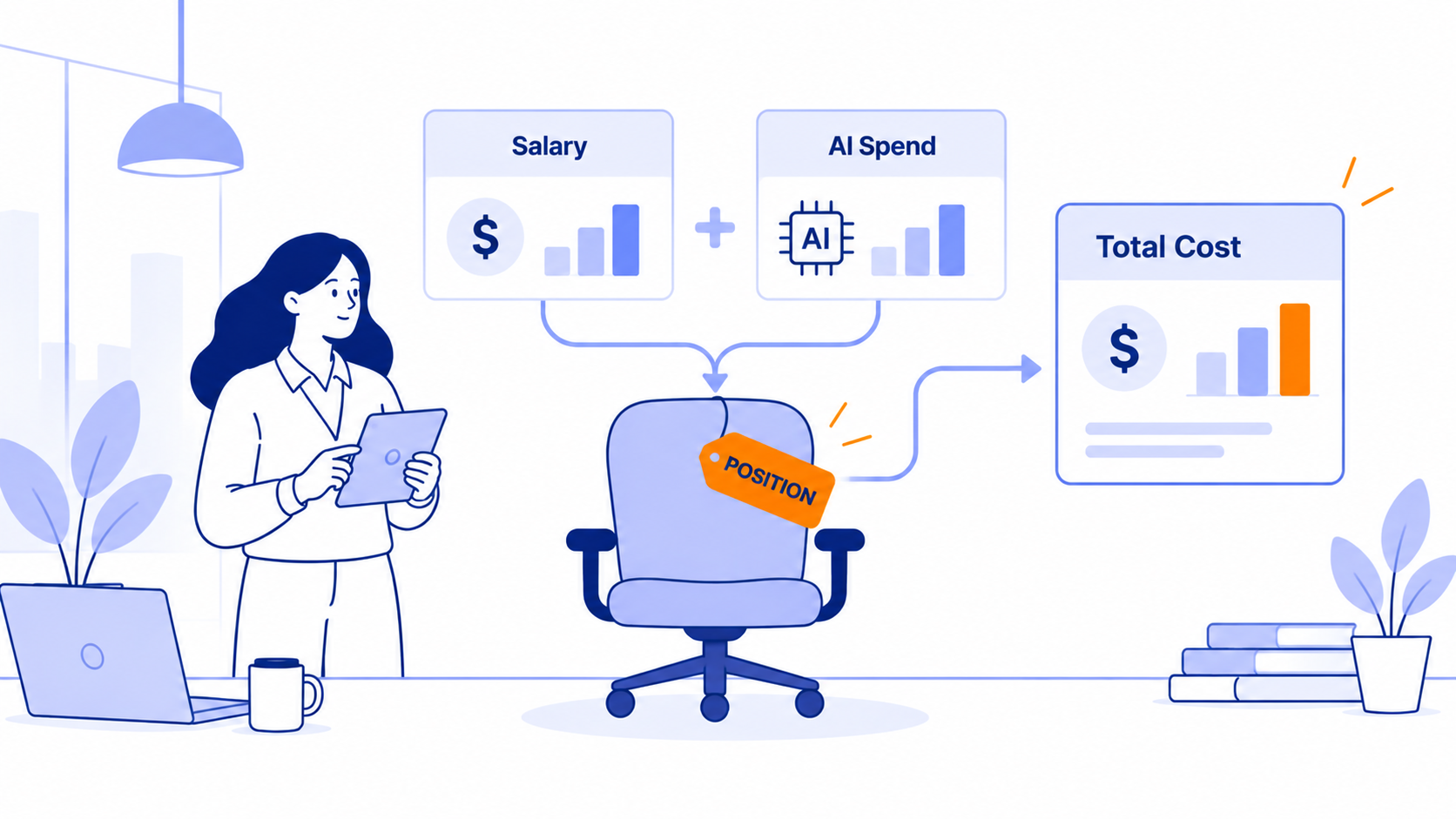
- AI spend behaves like workforce spend, so it belongs in the headcount plan rather than a software line.
Why does AI spend run over budget?
AI spend runs over because the bill is driven by usage, and most budgets were built like a software line: seats times price. A seat price is fixed but token usage is not. It moves with the person, the model they pick and the work they are doing that week.
The swings are large. Spendesk's 2026 European Software Spend Report found that 60% of companies saw significant month-to-month swings in AI spend, and that peak months cost up to 8x more than low months.
The head of enterprise IT at a mobility technology company described the same pattern with a coding tool his team uses. The seat price looked cheap, unlike the token charges.
"It can go up astronomically, 2, 3, 4 times of what you're expecting."
He told us he was already looking for a way to manage AI spend for next year. He is not alone. SpendHound's 2026 AI Spend Report found that 46% of finance and procurement leaders went over their AI budget in 2025.
What do companies do when the AI bill surprises them?
They cap it. Across conversations with Finance, People and IT leaders at more than 20 companies between August and October 2026, the most common control was a flat monthly allowance per person, with a manual approval for anything above it.
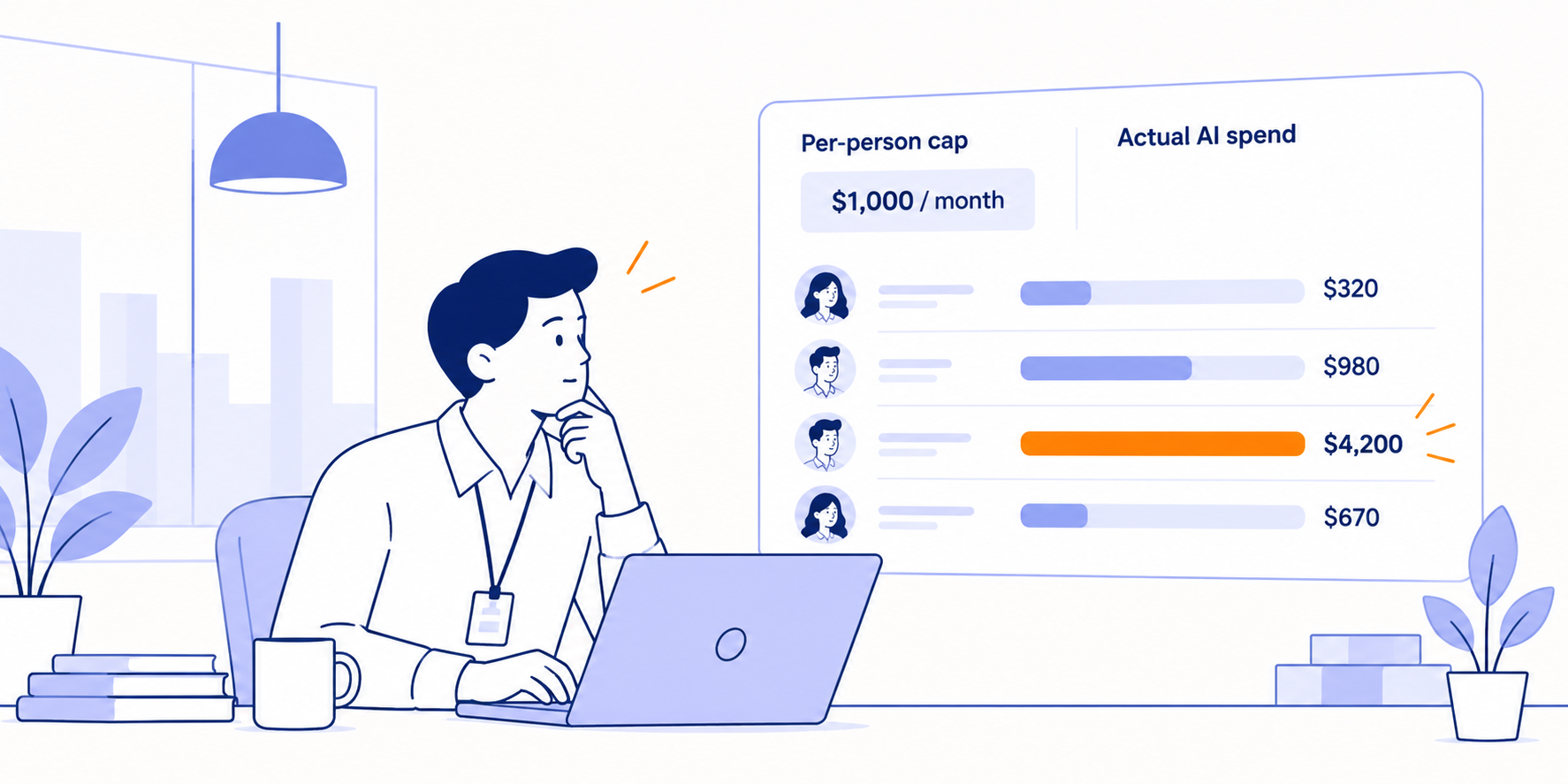
- A fintech company gives every employee $1,000 a month for one AI tool. Some engineers get $10,000. Overages go to the VP of AI for approval, usually another $1,000 at a time. Their IT lead called the result "a little bit all over the place."
- A finance leader at a trading firm told us his parent company capped everyone after usage spiked within a few weeks. He now gets a daily message with his own month-to-date spend against his cap. Unfortunately, that visibility stops with his own account. He has no way to see how his team is trending.
- A Talent leader at a SaaS company described the employee side: "we maxed out our usage and then we have to request more."
Large companies do the same. The SaaS CFO reported that Uber used up its 2026 AI coding budget by April and responded with a cap of $1,500 per employee per tool each month.
What do per-person caps fix, and what do they miss?
Caps fix the total by putting a ceiling on the bill and forcing a conversation when someone goes over. In the first month of a rollout, that is useful.
Caps miss the difference between valuable spend and wasted spend. An engineer running a large migration with heavy model use and someone running a job every hour to look busy hit the same ceiling. A finance analyst at a software company named that risk directly.
"You can have somebody that's consuming a ton of tokens and not necessarily really getting any improved productivity from it because you can game it."
Caps also lag. Cursor's documentation notes that spend limits are not enforced instantly, so usage can briefly run past the limit. A cap tells you someone went over, but it does not stop it in real time.
The bigger gap is the plan. A cap is a control, and a control is not a forecast. When Finance builds the 2027 plan, a $1,000 allowance per head tells you the ceiling. It does not tell you what the work costs, or what a new hire will add.
What should you compare AI spend against instead?
Compare each person's spend to their team's baseline, and compare total AI spend to payroll. Those two comparisons separate the spend worth funding from the spend worth questioning.
A team spending heavily can be a work style. One person spending ten times their team's baseline is a problem worth a look. Baselines separate the two. A raw total cannot.
The second comparison puts AI next to the cost it most resembles. AI spend as a percentage of payroll is total AI spend for a person, team or company divided by payroll cost for the same group over the same period. Section's 2027 planning guidance, based on what it saw in 2026, put individual AI usage at 2 to 5% of salary for knowledge workers and 7 to 10% for engineers. Your numbers will differ. The ratio still gives Finance something to plan against, which a token count does not.
What to do before your next AI bill
- List every AI source: API accounts, seat licenses, enterprise plans, cloud bills and expensed tools.
- Attribute spend to people and teams, with a named owner on every API key.
- Set a baseline for each team and review outliers monthly, instead of reviewing only the total.
- Track AI spend as a percentage of payroll by team.
- Carry the result into the headcount plan, so next year's AI line is built from roles instead of this year's invoice.
How TeamOhana helps
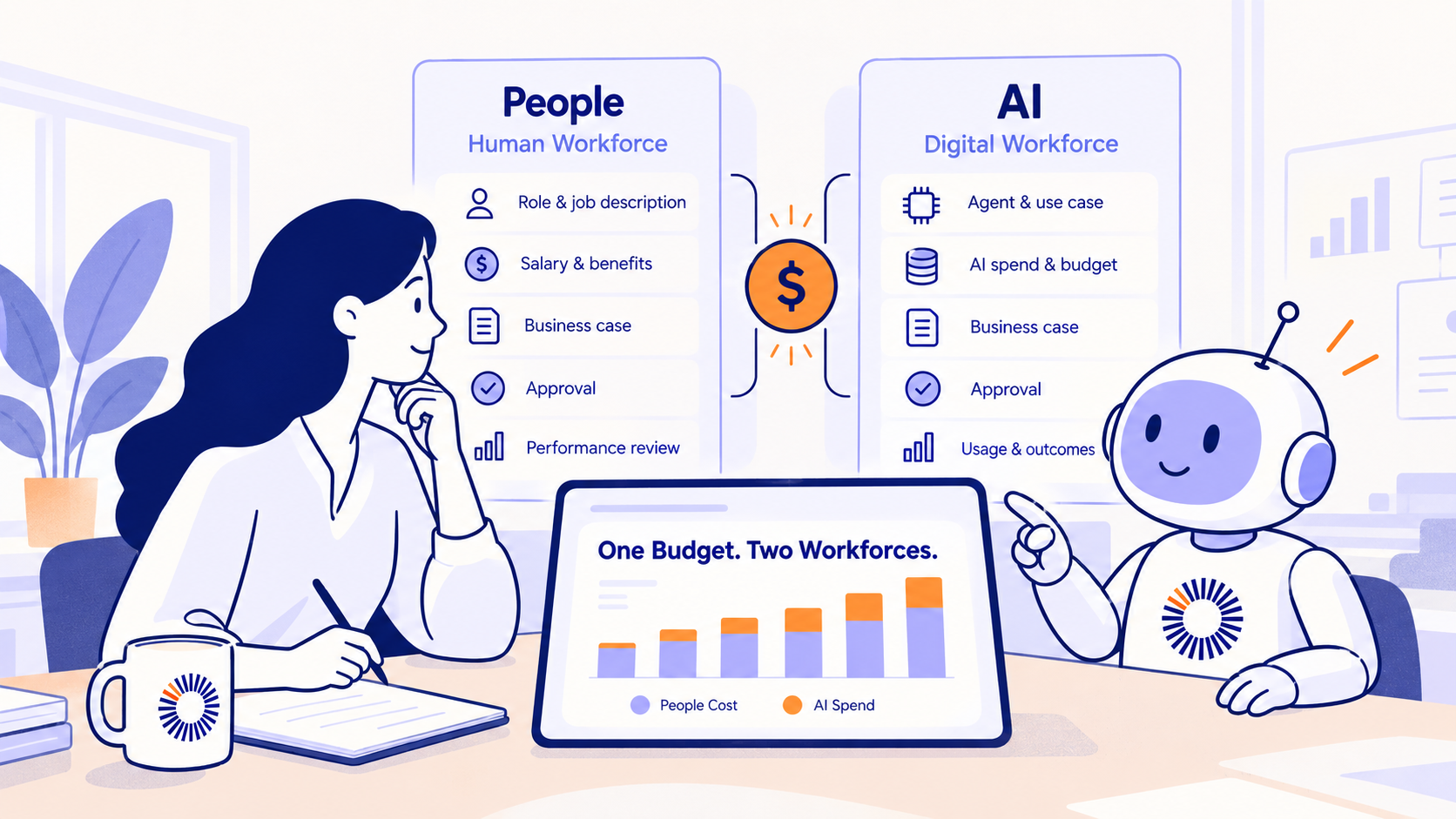
TeamOhana keeps one ledger for people and AI. Every dollar of AI spend is attributed to a person, a team or a digital co-worker, with an owner to contact. Outliers are flagged against team baselines, not raw totals. Because the ledger sits next to comp, Finance sees AI spend as a percentage of payroll and budgets both in the same plan. See AI spend as a percentage of payroll.
New to the idea? Start with why AI spend belongs in the headcount plan. Next in this series: Who spent it? Why AI cost attribution breaks at the invoice and How to budget AI spend in your 2027 headcount plan.
Sources
- SpendHound, AI Spend Report: 2026 Edition (survey of 172 finance and procurement leaders), spendhound.com/blog/ai-cost-management
- Spendesk, European Software Spend Report 2026, as reported by Procurement Magazine
- Ramp, Ramp AI Index, June 2026, ramp.com/data/ai-index-june-2026
- Section, Everything You Need to Know When Building Your 2027 AI Plan, sectionai.com
- The SaaS CFO, on Uber's 2026 AI coding budget (verify against the original report)
- Cursor documentation, Teams pricing and spend limits
- TeamOhana conversations with finance, People and IT leaders, Aug to Oct 2026 (anonymized)
Take control of your headcount spend

AI spend over budget FAQs
Simplifying TeamOhana: your questions, answered.
Most AI tools charge by usage, while most AI budgets were built as a fixed seat cost. Usage changes by person, model and week, so the bill moves faster than a fixed line can track.
A cap is a reasonable short-term control. On its own it cannot tell valuable use from waste, and it does not forecast next year. Pair it with team baselines and attribution to people and roles.
It varies widely. The Ramp AI Index for June 2026 found the top 10% of firms spent $611 per employee per month and the top 1% spent $7,450. Comparing your own teams against each other tells you more than an outside average.
It is AI spend for a person, team or company divided by payroll cost for the same group and period. It shows AI next to the workforce cost it supports, which makes it usable in a headcount plan.
Attribute each person's AI spend across every tool to their team, then take the team's typical monthly spend per person. Review anyone far above that baseline each month. A baseline separates a heavy-use work style from a single outlier, which a company-wide total cannot do.