Curious how TeamOhana can help you? Talk to us.
In this article
Never miss new content
"Every year we make this hiring plan and no one really utilizes it."
A talent lead at a 250-person trading firm told us that in September. At the time, four versions of the company's 2026 hiring plan were in circulation. None had been officially approved. The company had been hiring all year anyway.
Most companies treat headcount management as the tail end of workforce planning. In practice, it is most of the work. The plan is set once. The org changes every week after that.
This post walks through what breaks after the plan is approved, and what the teams that fixed it did differently.
What is headcount management? Headcount management is the ongoing work of keeping an approved plan accurate as the org changes, with every backfill, transfer, level change, and reorg recorded against one number that Finance, HR, and Talent share.
Key takeaways
- Workforce planning is an annual event. Headcount management is daily work, and most of it happens after the plan is approved.
- Once the number is allocated, Finance steps back. HR and Talent carry the plan through every backfill, transfer, level change, and reorg.
- In one two-week stretch this September, roughly 25 of our conversations with Finance, HR, and Talent leaders described this drift, across at least 14 companies.
- The drift does not stop in a hiring freeze. Flat headcount needs more precision, because every dollar is already committed.
- Teams that record every change as a decision get the time back. Greenhouse cut reconciliation from about 60 hours a month to 1 to 2 hours a week.
What happens after the headcount plan is approved?
The plan starts moving, and Finance stops watching it closely. Bev Carleton, VP of People, Strategy, and Operations at TeamOhana, has run HR and Talent teams through this cycle for years. Everyone pays attention during workforce planning. Finance, HR, and Talent leaders all listen for early numbers so they can size their own teams. A plan built in January often isn't reconciled until March. Then the allocation goes out, and the attention shifts.
"Once the allocation has happened, finance goes away. TA and HR are trying to figure out where the head's going to go," Bev said.
From there, HR translates dollars into heads. A $1 million allocation becomes a set of roles at specific levels. Hiring managers start asking how close they are to budget. Then the business moves. Sales launches a new product and needs BDRs, so 10 heads move from product to go-to-market, with a promise to give them back next quarter.
"All of this is happening after the plan has been delivered, and it's just a game of Go Fish trying to figure out where these heads are and what's open."
Workforce planning sets the number once. Headcount management keeps it true every week after that.
Why does the headcount number drift so fast?
Each change after approval happens in a different channel, and nothing ties it back to the plan. Across our calls, the same mechanisms come up again and again.
Changes happen in side conversations
A finance leader at a 550-person fintech described it plainly: "Finance or people is essentially blindsided because there are side conversations being had on Slack or verbally about changes to headcount that nobody flags to us."
Backfills are rarely like-for-like
A People leader at a 235-person SaaS company told us, "We're not hiring like for like. We moved somebody internally to something else and then their backfill is not like for like." Her short list of what the spreadsheet misses: "the role that shouldn't exist anymore, and the role that doesn't exist, but should."
Offers drift above the approved number
At a 200-person construction software company, the finance and people team walked us through a common case. A role is budgeted at $100,000 and the candidate gets an offer at $110,000. Repeat that across a year of hiring and, in their words, "you're out of budget 10%."
A $100,000 role that closes at $110,000 is 10 percent over plan. Repeat it across every hire in a year and the whole hiring budget runs 10 percent over.
Reorgs outpace the plan
At a large AI cloud company, a recruiting leader asked her people systems colleague whether org changes could move to a quarterly cadence. The answer: "We wish."
Held roles disappear from the plan
An HR leader at a medical device company described a sales leader quietly holding the headcount of employees who had left. HR and Finance didn't know. The roles never made it back onto the workforce plan, and untangling it took five people in HR and three people in Finance.
The executive view is no better. The People leader at the 235-person SaaS company said her CRO likes to "play Tetris with my headcount" but can't see how the moves play out across the org.
Does headcount management matter if you're not growing?
Yes, and the stakes go up. "Headcount management is up or down. You still have to manage the heads that you have," Bev said.
In a growth year, a loose plan costs time. In a flat year, it costs money the company doesn't have. A senior finance leader at a mid-market SaaS company holding headcount flat told us, "We're trying to lean into AI and not be growing our headcount. Maybe not backfill some of the roles." Each of those decisions needs a record, or the savings disappear into the next reconciliation.
Bev's description of the job in a flat year: "I'm applying discipline to the money I already have."
Where does scenario planning fit after the plan is approved?
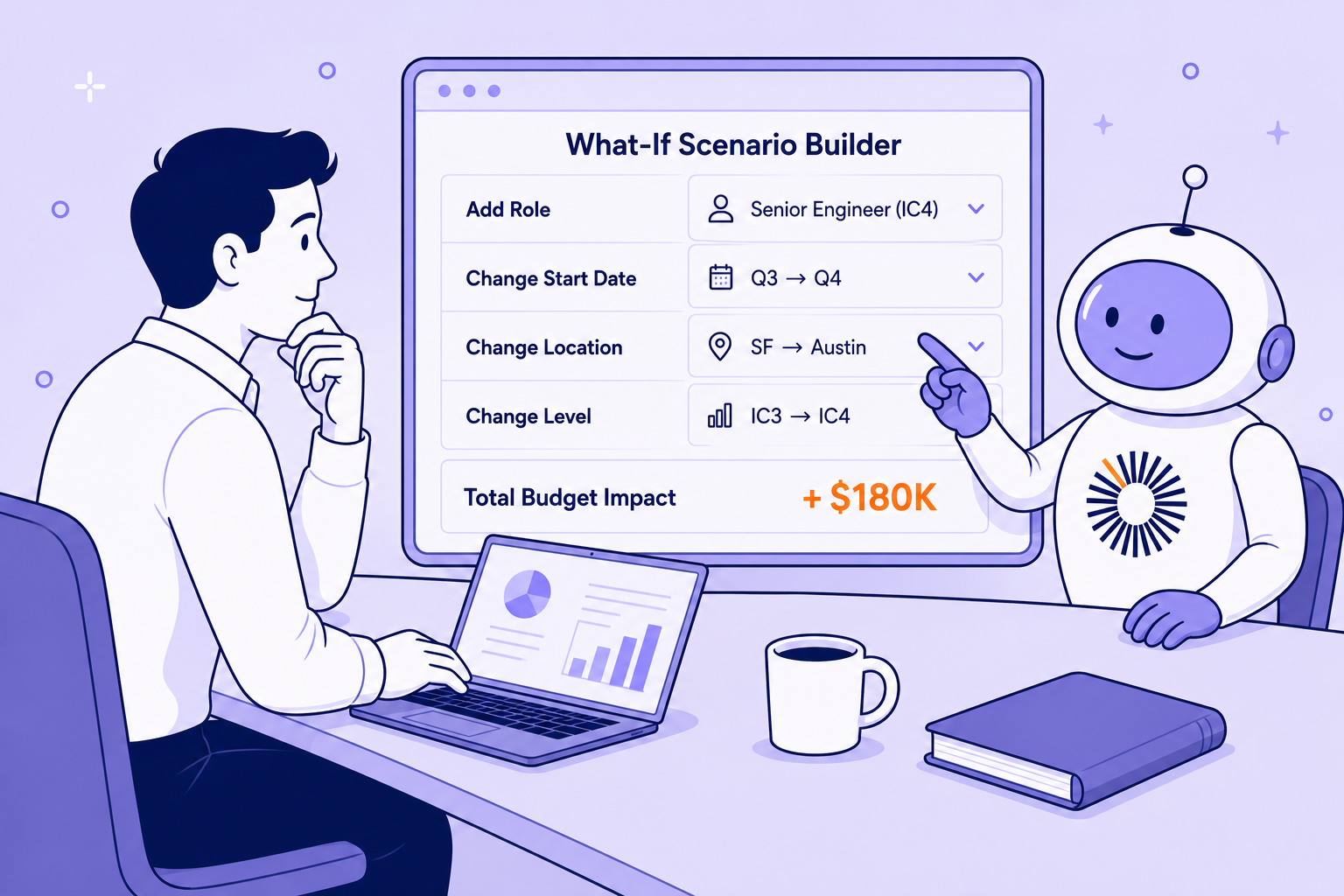
Scenario planning is how HR answers the next executive question without derailing the team. Bev says it gets the strongest reaction from Talent leaders, because the questions never stop. What if we cut all contractors? What if we stop hiring in one geography? What if we take 20% off each level?
Without a model, each question becomes a manual project for HRBPs and TA partners. The fintech finance leader described how his team handles a request to push every start date to mid-next-year: "Today we just kind of do background math."
An HR leader at a government-contracting AI company, where headcount more than doubled in six months, described two plans running side by side: "You have this factual headcount plan tied against timelines. And you have this what if headcount plan tied against potential contracts getting ready to close. Scenario planning is probably the biggest thing."
Cedar built its annual budget in TeamOhana's scenario planning, with every leader entering the business justification for every role. As the year reshaped the plan, each change was captured with its rationale.
What does continuous headcount management look like?
Every change becomes a recorded decision against one number that Finance, HR, and Talent all see. The companies that made this shift did it in four ways.
Make each change once, in one place
Greenhouse tracked its headcount number across at least five systems. Moving one role from the US to EMEA meant updates in at least three systems and a handful of spreadsheets. Now a change is made once, after approval. Reconciliation fell from roughly 60 hours a month to 1 to 2 hours a week, and formal approval went from up to two weeks to about three business days.
Turn backfills into decisions
Cedar used to open a backfill the moment someone left. Now leaders review their org in TeamOhana and decide whether to refill, repurpose, or absorb the role. Finance-to-Talent reconciliation dropped from three to four hours a week to 20 minutes or less, and Cedar surfaced more than $1.5M in headcount spend.
Keep an approval record anyone can check
At Sprout Social, approvals stalled for 2 to 4 weeks while teams dug through old Slack threads and emails to prove a role existed. With a full record of who approved what and when, turnaround dropped to under a day.
Answer the fire drill without pulling a report
Rad AI grew from about 80 to more than 220 employees in 18 months on one plan. "Every talent leader has had the fire drill Slack message. I just click over to a tab and I have the answer in two seconds," said Will Barnett, Head of Talent.
TeamOhana Position Management carries this through to the role itself. Each approved position keeps an ID from approval through hire, so a backfill, a transfer, or a level change stays tied to the original decision.
The plan sets the budget. The year decides whether you hit it.
Workforce planning still matters. It sets the envelope the board approves. Even the U.S. Office of Personnel Management's Workforce Planning Guide treats it as a cycle, with a final step to evaluate and revise the plan as conditions change. Whether the company lands inside that envelope depends on the other 11 months of moves and what-ifs. That work deserves a system as much as the plan does.
Want to see it in action? Watch a headcount move from approval to hire in a 20-minute demo. Book a demo.
Patterns cited in this article are drawn from TeamOhana's conversations with Finance, HR, and Talent leaders in September 2026. Prospect references are anonymized. Customer results come from published TeamOhana customer stories.
Take control of your headcount spend

FAQ
Simplifying TeamOhana: your questions, answered.
Workforce planning is the annual process of setting the headcount budget that leadership and the board approve. Headcount management is the daily work of keeping that plan accurate after approval, through every backfill, transfer, level change, and reorg. Most of the effort, and most of the budget risk, sits in headcount management.
Changes happen in separate channels, like Slack threads and side conversations, and nothing ties them back to the approved plan. Backfills are rarely like-for-like, offers close above the budgeted number, reorgs move faster than the plan, and leaders sometimes hold open roles that never return to it. Each change is small, but together they pull the number away from what was approved.
In most companies, Finance steps back once the allocation goes out, and HR and Talent carry the plan for the rest of the year. HR translates dollars into roles at specific levels, and Talent hires against them. Without a shared system, Finance often learns about changes only at the next reconciliation.
Yes. When headcount is flat, every dollar is already committed, so each decision to backfill a departure or absorb the work needs a clear record. Without that record, the savings from roles left unfilled can disappear in the next reconciliation.
Executives keep asking what-if questions after approval, such as cutting contractors, pausing hiring in a region, or pushing start dates out. Scenario planning lets HR model those questions against the live plan instead of rebuilding a spreadsheet for each one. Some teams also run a committed plan alongside a what-if plan tied to deals that have not closed yet.
Treat each backfill as a decision, not an automatic refill. Before a req opens, the leader reviews the org and decides whether to refill, repurpose, or absorb the role. Cedar made this change in TeamOhana and surfaced more than $1.5M in headcount spend.
Position management gives each approved role its own record that persists from approval through hire. In TeamOhana Position Management, each position keeps an ID, so a backfill, transfer, or level change stays connected to the original decision. Finance, HR, and Talent get one traceable history for every seat.