.svg)
Curious how TeamOhana can help you? Talk to us.
In this article
Never miss new content
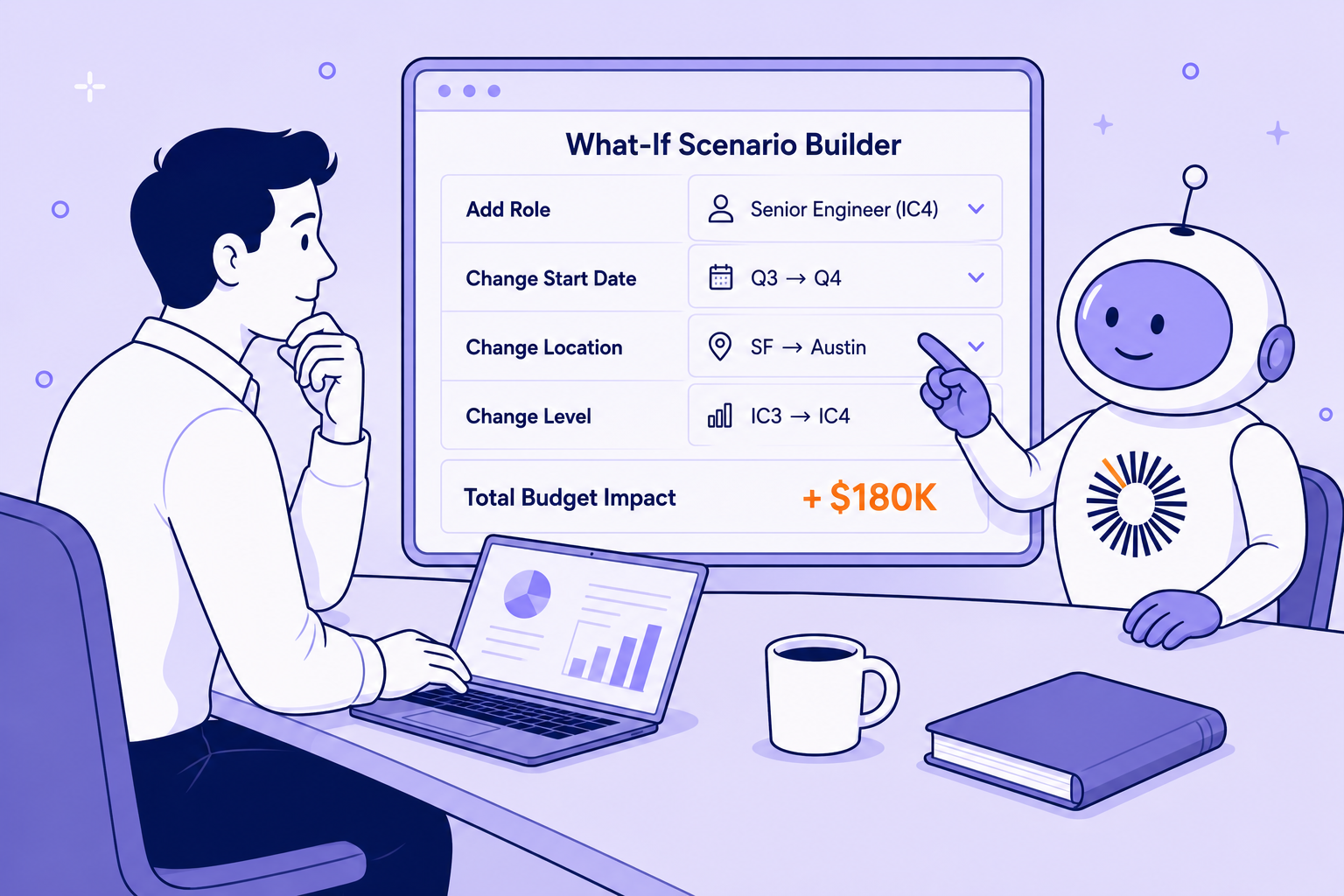
Headcount planning is fundamentally a question of tradeoffs. Do we hire the senior engineer now or wait until Q3? Do we backfill the role at the same level or use the vacancy to upgrade? Do we move the role from San Francisco to Austin, and what does that save us on an annualized basis?
These are not complicated questions in isolation. They become complicated when the answers require someone to pull data from three systems, rebuild a model in a spreadsheet, circulate it for review, receive conflicting edits, and reconvene to compare versions.
That process, not the underlying question, is where headcount decisions go wrong. The analysis takes too long. The window closes. The decision gets made informally on a deadline, without anyone seeing the full budget impact.
Key takeaways
- Most companies do headcount scenario planning once a year, during the annual planning cycle; the ones that do it continuously have a structural advantage
- A scenario is only useful if it reflects real compensation data, real budget constraints, and real time-to-fill estimates
- Finance should be able to see the full impact of a scenario across all departments while department leaders only see their own slice
- Scenario approval should function like headcount approval: tracked, auditable, and tied to a change log
- AI-recommended start dates based on historical time-to-fill data turn scenario planning from hypothetical to operational
Why is most scenario planning too slow to be useful?
Annual planning is a structured exercise. There is a defined window, a defined output, and a defined audience. Scenario planning throughout the year is different. It happens in response to specific events: a key departure, a budget reallocation, an unexpected opportunity, a directive from the board to grow faster or slower than planned.
Those events do not arrive on a schedule. And when they do, the people who need to model the headcount impact do not always have access to the data they need to do it quickly.
An FP&A specialist at a large software company described their team's process for mid-cycle scenario work. The challenge was tracking what changed from the annual operating plan, whether roles got pushed, pulled, added, or restructured mid-quarter. When they needed to understand the cumulative impact of those changes, the work was manual and time-consuming. It required pulling data from multiple systems. For what that variance tracking looks like when it is automatic, see Budget Envelopes and Variance Tracking.
Who should be able to run a scenario?
This is a governance question as much as a technology question. Scenario planning should be democratized, but not uncontrolled.
The head of engineering should be able to model what happens if they up-level two IC3 roles to IC4, push out a hiring start date by one quarter, and add a new team lead position. They should see the total cost impact of those changes against their own budget envelope. They should not see the finance team's full headcount model, other divisions' compensation data, or details above their access level.
Finance should be able to see everything. All departments simultaneously. The full aggregate fiscal-year impact of every scenario being worked on. Their view is the governance view.
A UK-based software company's finance leader asked exactly about this: could collaborators be invited to a scenario with limited access, seeing only their own headcount, while the person who created the scenario sees the full impact? That is the right design.
What makes a scenario calculation actually accurate?
Three inputs make or break the accuracy of a headcount scenario.
The first is compensation data. If a scenario models adding a new IC3 software engineer but uses a manually entered salary estimate rather than the actual compensation band from the job architecture, the number is wrong from the start. The right design pulls the comp band automatically based on the role, level, and location the planner selects. If they change the location from San Francisco to Austin, the comp band updates.
The second is budget envelope integration. A scenario should immediately show whether the proposed changes put a department inside or outside its budget envelope. Not as a separate calculation. As a live indicator embedded in the scenario interface. When the head of engineering adds a role and sees their projected spend move from $4.2M to $4.4M against a $4.1M envelope, they know in real time that they need to offset it elsewhere or request a budget expansion.
The third is time-to-fill data. This is the most underused input in headcount scenario planning. If a company has been averaging 72 days to hire senior engineers, modeling a Q2 start date for a senior engineering role is likely wrong. The right design uses historical hiring data to recommend a realistic start date based on the role, level, and location, and then surfaces the fiscal-year cost implications of that timeline.
How does a scenario move from planning to approval?
Scenario planning without an approval mechanism is just a modeling exercise. The output has to be actionable.
When a department leader finishes building a scenario and wants to put it into effect, that scenario should move through the same approval chain as any other headcount request. Finance reviews the aggregate impact. The appropriate approvers see the changes clearly laid out. They can approve the whole package at once or choose to approve individual headcounts selectively if the full scenario is not ready to commit.
The audit trail for a scenario approval is identical to the audit trail for a single headcount approval: who submitted, who approved at each level, what was changed, and when. If someone comes back in six months and asks why the Q3 engineering budget was higher than planned, the scenario record shows the specific decisions that drove it.
Is quarterly scenario planning realistic for most companies?
Most companies plan annually and then track the plan rather than formally revising it mid-year. That approach is reasonable for companies with stable, predictable growth. It is not adequate for companies that are growing fast, operating in uncertain environments, or managing headcount across multiple geographies and business units.
The connective layer approach makes quarterly reforecasting operationally practical. Because the plan is always live, because compensation data is always current, and because every change creates an automatic update to the forecast, running a quarterly replan does not require rebuilding from scratch.
A head of people at a mid-sized company described wanting self-service scenario planning so org leaders could run their own what-if analysis against their budget without scheduling a finance meeting every time. When access controls, data feeds, and the approval mechanism are all in place, quarterly scenario planning stops being a project and starts being a workflow.
See what connected headcount planning looks like for your finance team. Book a demo to see how scenario planning works when it is connected to your live headcount plan, your compensation bands, and your budget.
Patterns cited in this article are drawn from TeamOhana's recent conversations with CFOs, FP&A leaders, and HR executives across companies ranging from 300 to 3,000 employees. All references are anonymized and paraphrased.
Take control of your headcount spend

FAQ
Simplifying TeamOhana: your questions, answered.
Most scenario planning requires pulling data from multiple systems, rebuilding a model in a spreadsheet, circulating it for review, and reconvening to compare versions. That process is too slow to support mid-cycle decisions. By the time the analysis is done, the window to act has often closed.
Department leaders should be able to model changes to their own headcount and see the impact against their own budget envelope. Finance should see everything simultaneously across all departments. Tiered visibility means department leaders can do scenario work without requiring a finance analyst to build models for them, while finance maintains the governance view.
Three inputs make or break scenario accuracy: compensation data that pulls from actual comp bands based on role, level, and location; budget envelope integration that shows immediately whether proposed changes put a department inside or outside its budget; and time-to-fill data that uses historical hiring patterns to recommend realistic start dates.
A completed scenario should move through the same approval chain as any other headcount request. Finance reviews the aggregate impact. The audit trail for a scenario approval is identical to the audit trail for a single headcount approval: who submitted, who approved at each level, what was changed, and when.
Quarterly reforecasting becomes practical when the plan is always live, compensation data is always current, and every change creates an automatic update to the forecast. Running a quarterly replan does not require rebuilding from scratch. It requires reviewing what changed, modeling the implications, getting approval, and updating the connected systems.