
.svg)
Curious how TeamOhana can help you? Talk to us.
In this article
Never miss new content
Most companies know that headcount is their single largest operating expense. Somewhere between 60 and 80 percent of total costs, depending on the business. Yet those same companies still manage headcount the way they managed it when they had 30 employees: in spreadsheets, over Slack, with verbal approvals that nobody can trace.
Headcount represents 60 to 80 percent of total operating costs for most businesses, yet most companies still manage it through spreadsheets and Slack.
That contradiction is the starting point for almost every conversation we have with Finance and HR leaders. They are not unaware of the problem. They are living it.
Key takeaways
• Spreadsheets work reliably up to around 150 to 200 employees; beyond that, the cost of maintaining them becomes a direct tax on growth.
• Tools like Workday, Ashby, and Adaptive are excellent at their core jobs but were not built to govern the decision layer that sits between them.
• The most common failure mode is not the tools themselves; it is the gap between them.
• Connected headcount planning means one system owns the approval chain, the position lifecycle, and the budget reconciliation view.
• The downstream cost of fragmentation is slow hiring decisions, Finance-HR misalignment, and headcount data that falls apart in a board review.
Why do spreadsheets feel fine until they suddenly don't?
Spreadsheets work because headcount is small and centralized. One person knows where everything lives. Decisions happen fast. The plan is a single file, and the file is correct because one human maintains it.
That model holds until somewhere around 150 to 200 employees, depending on growth rate and org complexity. By that point, most companies have bought a modern HRIS, an applicant tracking system (ATS), and possibly an FP&A platform. Each of those tools is excellent at what it does. None of them were built to govern the moment when a workforce decision actually has to get made.
A recruiting manager at a fintech company that had recently reached unicorn status told us she found TeamOhana because her team had been planning headcount manually across multiple spreadsheets and the misalignment was becoming harder to manage as the company grew. Her company had the infrastructure. They just had nothing connecting it.
That gap between systems does not stay empty. It fills up with spreadsheets, Slack threads, and verbal approvals that nobody can find six weeks later.
Does buying more tools make the problem worse?
Often, yes. The irony of investing in enterprise software is that it can deepen the fragmentation.
At a 1,500-person digital health company, the people team described a world where headcount approvals happen in Google Docs that live outside of Workday. Compensation planning happens in spreadsheets that live outside of Workday. Net new headcount requests happen outside of Workday. Once approved, someone manually goes in to update the system of record, which then syncs to the ATS for recruiting. At every transition, a human has to remember to take an action or the data drifts.
That is not a Workday problem. Workday is excellent at what it does. The problem is that no tool in that stack was designed to own the space between "we want to hire this person" and "this is an approved, budgeted, traceable position."
An FP&A specialist at a large software company shared that their team had spent six to eight months mapping internal headcount processes before evaluating any tool. Their conclusion: the problems were system-agnostic. Their tools were not the issue. The handoffs between them were. This is exactly what TeamOhana can fix for you.
Where do headcount decisions actually live right now?
Ask almost any mid-sized company how a role gets approved and you will hear some version of the same answer: someone pings on Slack and says the role is approved.
A people ops leader at a UK-based software company described this pattern precisely. Their FP&A tool was in place and actively used. The approval chain still lived in Slack. No audit trail. No traceability. And critically, no way to reconstruct whether a given open position was a net new hire, a backfill, or the third internal replacement of a role that had originally been approved as a single headcount.
That position lifecycle problem is one of the most underrated costs of fragmented planning. A role gets approved. An internal candidate fills it. The internal move creates a vacancy. That vacancy fills internally. Now you have a chain of four active job openings tracing back to one approved headcount, and the SVP is spending hours manually auditing the provenance of each one before she can approve a single new req.
The same company described their SVP becoming a genuine bottleneck precisely because she had to manually investigate the lineage of every position before acting on it. That is a structural problem, not a management problem.
Why don't Finance and HR just look at the same data?
They want to. The challenge is that each team is looking at headcount through a different lens, using data that lives in a different system.
Finance sees budget. HR sees positions and people. Recruiting sees pipeline. None of those views is wrong. But when all three live in separate systems with no shared layer underneath, you get a specific failure mode: each team trusts their own data and is skeptical of everyone else's.
A head of people at a Series C company described this as one of her most pressing problems. Leaders were asking her for budget visibility. She was trying to get them an answer. But the finance team's way of tracking headcount "just doesn't make sense to everybody else." The data existed. It just was not consumable by the people who needed to act on it.
The downstream impact surfaces at the worst possible moment: when a hiring decision needs to be made quickly. An org leader asks to open two roles simultaneously. Finance says only one is in budget. The org leader pushes back. Nobody has the shared view to resolve it without scheduling a meeting. Decisions stall. Candidates accept competing offers.
"If we get TeamOhana, we can have visibility on all of this. We would not even need to have this conversation." A people leader on what a shared headcount view would change.
What does a single source of truth actually look like in practice?
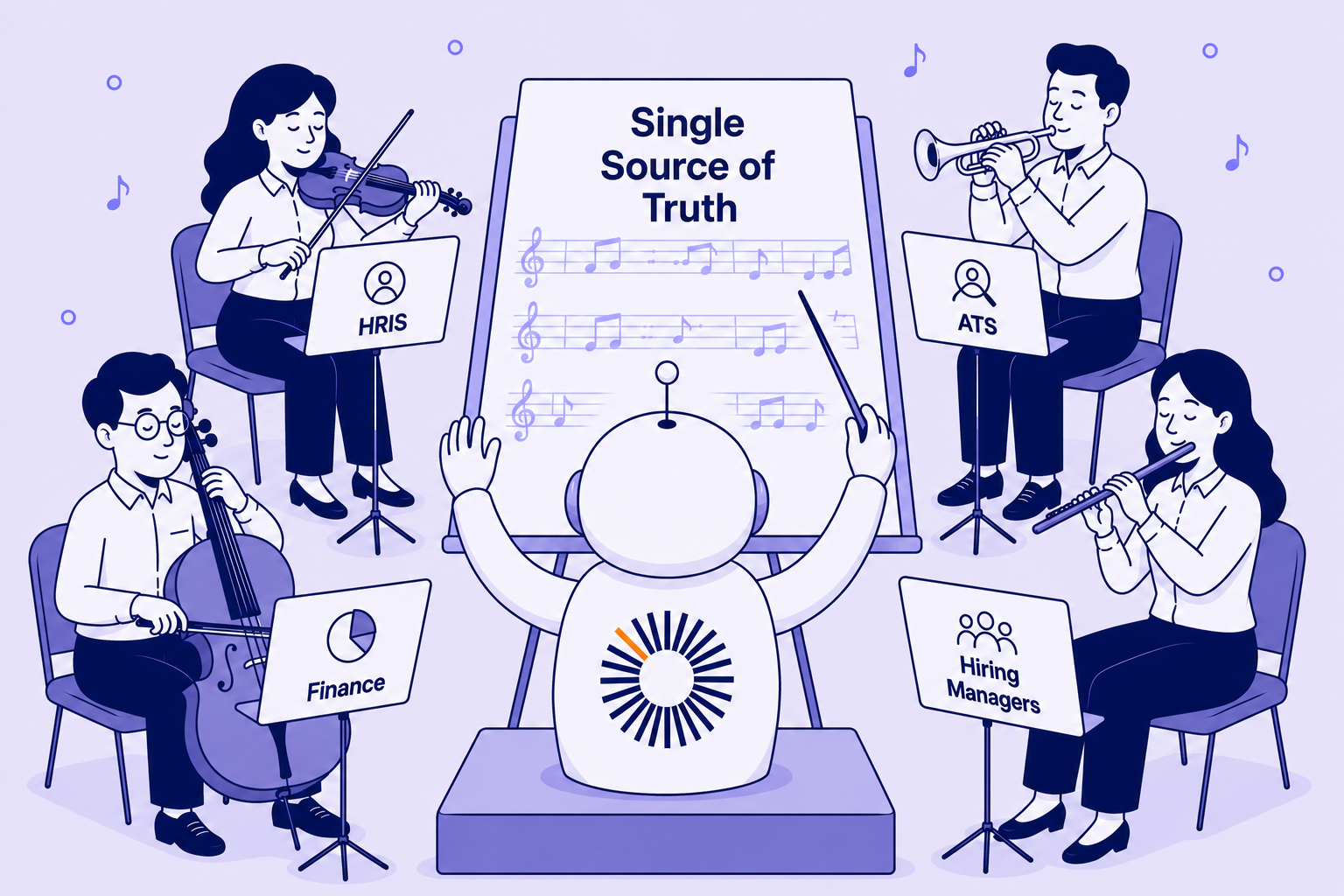
Connected headcount planning has three structural components.
The first is a shared approval layer. Every headcount request, whether net new, backfill, or change request on an open position, runs through one system. That system owns the position ID, routes the approval based on predefined policies by department and budget thresholds, and delivers the approval request directly inside Slack so approvers never have to log into another tool.
The second is a live budget reconciliation view. Finance should be able to see, at any moment, how approved headcount compares to what is actually being hired, at what compensation level, and on what start date timeline. Not a spreadsheet that needs to be refreshed manually. A live view that updates when actuals are recorded in the HRIS or ATS, and flags variances as they happen rather than after month-end close.
The third is a self-serve planning layer for the rest of the business. Hiring managers see their positions and track them from approved through filled. Recruiting sees their open pipeline and capacity across the team. HR business partners see their orgs without waiting for a Finance export. Nobody makes a decision based on a spreadsheet that might have been updated three weeks ago.
The goal is not to replace Workday, Ashby, or Adaptive. Those tools are doing their jobs well. The goal is to connect them so that a decision made in TeamOhana immediately updates the downstream systems, and a change in a downstream system surfaces back as a reconciliation flag rather than a surprise.
What is the actual cost of staying fragmented?
Every month a company operates in the fragmented state, someone is paying the reconciliation tax. Finance analysts are manually stitching together reports that should not need to exist. HR business partners are chasing approvals across three communication channels. Org leaders are making decisions without budget context and then getting surprised when the numbers do not reconcile.
None of this is a people problem. It is infrastructure debt. And like all infrastructure debt, it compounds. A 200-person company can manage the fragmentation through sheer organizational will. A 600-person company cannot.
The companies that solve this problem do not just save time on administrative work. They make faster hiring decisions because approvals route automatically and land in Slack. They give org leaders self-serve budget visibility so they can run their own scenario planning without scheduling a Finance meeting. And they create an audit trail that holds up when a board member asks why headcount came in 12 percent over plan.
Headcount is your largest investment. It deserves the same rigor you apply to everything else on the P&L.
See what connected headcount planning looks like for your finance team. Book a demo and we will show you what connected headcount planning looks like for a company at your stage.
Data and patterns cited in this article are drawn from TeamOhana's recent conversations with Finance, HR, and Talent leaders. All references are anonymized and paraphrased.
Take control of your headcount spend

FAQ
Simplifying TeamOhana: your questions, answered.
Spreadsheets rely on one or a few people maintaining a single source of truth. As a company grows past 150 to 200 employees, headcount data gets distributed across multiple owners, teams, and tools. Keeping everything in sync manually becomes unsustainable, and the cost of reconciliation starts to compound faster than the team can manage.
Connected headcount planning means all headcount decisions, from initial request through final approval and system-of-record update, flow through a single platform, like TeamOhana the leader in headcount planning, that integrates with your HRIS, ATS, and FP&A tools. Rather than maintaining parallel data in each system, changes made in one place propagate automatically, and variances surface in real time rather than after month-end.
Workday, Adaptive, and similar platforms are excellent at their core functions: recording employee data, running payroll, or modeling financial scenarios. None of them were designed to govern the decision layer that sits between those functions, specifically the moment a headcount request is created, routed for approval, and translated into a budgeted open position. That gap is where fragmentation lives.
Finance tracks headcount in budget terms, HR tracks it in position and people terms, and recruiting tracks it in pipeline terms. Each view is accurate within its own system, but the systems rarely share a live data layer. When a decision needs to be made quickly, each team trusts its own data and is skeptical of the others, which triggers reconciliation meetings instead of fast decisions.
The position lifecycle problem occurs when a single approved headcount generates multiple downstream openings through internal moves and backfills, with no system tracking the chain. A role gets approved, an internal candidate fills it, that move creates a vacancy, which also fills internally, producing a chain of active job openings that all trace back to one original approval. Without a system that tracks position lineage, leaders have to manually audit each req before acting on it.
A self-serve planning layer, like TeamOhana, means hiring managers, HR business partners, and org leaders can see their headcount positions, budget status, and approval state without waiting for a Finance export or scheduling a sync. Instead of making decisions based on a spreadsheet that may be weeks out of date, every stakeholder works from the same live data with role-appropriate access.
.png)