

Curious how TeamOhana can help you? Talk to us.
In this article
Never miss new content
Nobody wants to plan a RIF. Someone still has to.
There's no fun version of this post. A reduction in force (RIF) is the nuclear option, and nobody in Finance, HR or Talent wakes up hoping to build one.
But when the numbers turn, someone has to model it. Usually fast, quietly, and with decisions that carry consequences well beyond the numbers.
We sat down with a finance leader who has worked through more than one RIF. We also listened to how the Finance and People teams we talk with every week have handled it.
Here's how it happens, and how to make a hard call a lot clearer.
What is a reduction in force (RIF)? A RIF is a permanent cut to headcount to bring costs back in line with revenue. The roles are eliminated rather than backfilled, which is why the headcount plan, not just the payroll file, has to change with it.
How a RIF actually gets planned
A RIF doesn’t show up out of nowhere. It starts with the revenue line.
"If you're hitting your revenue targets, everything else is fine."
— Finance leader, SaaS
A quarter or two of slower growth usually gets a pass. Seriously missing targets doesn't. Neither does burning cash without the growth to justify it. Many finance teams check this with the Rule of 40: revenue growth plus profit margin should add up to 40% or more. Growing 70%? You can burn 30%. Growing 20%? You'd better be making 20%.
The Rule of 40: revenue growth + profit margin ≥ 40%. Fall well short for more than a quarter or two, and the headcount conversation usually follows.
There's a second trigger nobody likes to say out loud: hiring for a future that didn't show up. As this finance leader put it, "We have all these people we hired because we thought we're going to continue growing."
Once leadership decides something has to change, the process looks similar from company to company:
- Finance redraws the envelope. The plan starts with revenue targets, then sets spending guardrails by function. R&D might get around 40% of revenue, G&A stays at 10-15%, and Sales and Marketing are held to a CAC payback target (under 12 months is great, 12-18 is normal). When revenue drops, finance recalculates the envelope and finds the gap.
- Non-people costs go first. Unused software, consultants, vendors, ad spend. Anything that isn't a person in a seat today.
- Hiring pauses. "What preempted RIFs was always a pause in hiring." Two missed quarters is a common trigger. Backfills only, with extra approval.
- Leadership sets the number. If pausing hiring doesn't close the gap, the CEO or CFO hands down a target: cut this much, which works out to roughly this many people.
- The spreadsheets go out. Team leads list their people, their roles, and why. Teams weigh the priority of the work, performance, and tenure, usually protecting long-tenured people where they can.
- Finance rolls it up, again and again. Salary, location, benefits, even the per-seat tools tied to each person. Then it gets checked against the target. "Typically, you haven't cut enough, because no one wants to cut anyone."
- Legal and the board weigh in. Notice rules can kick in above certain sizes, so teams watch how big each reduction is. Severance is a one-time cost spike, and the board story becomes "one rough quarter, then a healthier run rate."
Where it gets messy: what we're hearing from Finance and People teams
What we covered is the playbook. Here's what it sounds like on the ground, in three stages: before the cut, while you model it, and after. (All quotes are anonymous, from Finance, HR and Talent leaders we've talked with this year.)
Before: the plan shrinks first
Long before anyone's name goes on a list, the plan itself gets smaller. Envelopes shrink, open roles get archived, and someone at the top sets a cap. A finance lead at a fintech company put the result plainly:
"We cannot approve all the positions in the plan because their envelopes got smaller."
— Finance lead, fintech company
An FP&A analyst at an insurance software company of about 450 people described how the cap arrives:
"Come back from the top and say, well, we need to cut down to this headcount, rather than just letting everyone hire whoever they want."
— FP&A analyst, insurance software company of about 450 people
Backfills tighten too. One People leader told us managers now have to "make a case for a backfill." Every one of these steps lowers the run rate without touching a person, but only if you can see every open seat.
During: model both scenarios with real people in them
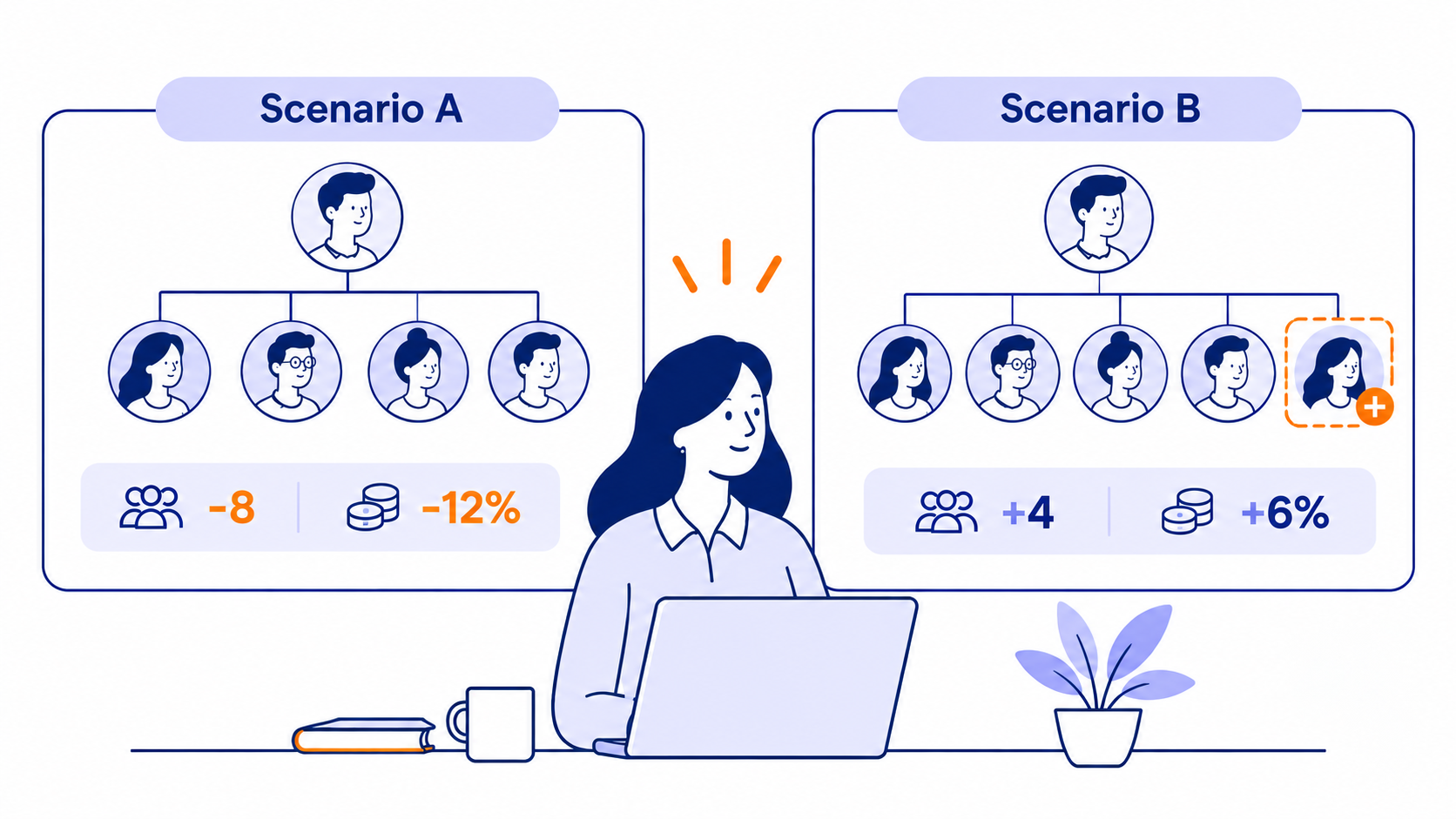
Once the gap is clear, the question is which lever to pull. A hiring freeze is one scenario and a RIF is another, and most teams want them side by side, with actual people and costs in the model.
The questions are practical. An HR operations and recruiting lead at a restaurant tech company of about 500 people asked, "If there is a hiring freeze, or a big layoff, for example, do we include the current headcounts?" A finance leader at an insurance company of about 1,000 people wanted to test "if our business is underperforming by 20%," and how many heads to slow down: "three or four or five."
One-time costs come up early, too. When a finance leader watched a reduction modeled in a demo, the first thing she asked about was severance: "I think that's important." The run rate gets the headlines, but the quarter the RIF happens in is where severance hits.
After: keep the plan honest
The announcement isn't the end. Somebody still has to clean up the plan, and that's where spreadsheets really start to hurt. There are two ways it goes wrong.
The first is blurring RIF exits with normal turnover. A People operations leader at a healthcare data company was clear about it:
"It was an actual reduction in force. So I don't want that to be part of the attrition calculation."
— People operations leader, healthcare data company
Mix them together and your forecast starts asking for backfills you'll never approve.
The second is cutting too fast. One Talent leader expected some of the open roles cut in a reorg to come right back: "They'll realize we shouldn't have cut these four."
Teams that have been through this more than once want a permanent fix. A People team at a fintech company told us they'd been through several RIFs in three years, and now, finally stable, they wanted "a more organized org understanding." Translation: one place where the plan actually matches reality.
What better looks like
Let's be clear about one thing. No headcount tool should tell you to run a RIF. That call depends on revenue, cash and strategy, and it belongs to your leadership team.
What a good workforce plan can do is make a hard decision a lot clearer. That looks like this:
- Every seat is in one place. Filled, open, planned and eliminated positions sit in the same plan, by team, so nobody is stitching together spreadsheets in a crisis.
- Scenarios run side by side. Pause hiring. RIF only. RIF plus a hiring pause. Each one shows the cost impact by team and function, including the costs people forget, like severance and per-seat tools.
- Guardrails are built in. Finance can set limits, like keeping cuts under 5% per team or protecting revenue-generating roles, and see what's still possible.
- RIF exits stay separate from attrition. Your forecast doesn't start asking for backfills you never plan to approve.
- Eliminated roles stay visible after the dust settles. When you start hiring again, you can see what you cut and decide what to bring back on purpose.
The bottom line
A RIF is always going to be hard. But it can be less chaotic.
If you do workforce and headcount planning, you can see every open and filled seat before the number comes down, model a hiring pause against a RIF in minutes instead of weeks, put the real cost on the table (severance included), and keep your plan honest long after the announcement.
TeamOhana gives Finance, HR and Talent one shared view of headcount, so the hardest decisions are at least clear ones.
See what connected headcount planning looks like for your finance team. Book a demo.
Take control of your headcount spend

RIF and layoff planning FAQs
Simplifying TeamOhana: your questions, answered.
A reduction in force (RIF) is a permanent cut to headcount to bring costs back in line with revenue. The roles are eliminated rather than backfilled. Because of that, the headcount plan, budget and forecast all need to change along with the employee records.
The most common trigger is seriously missing revenue targets, or burning cash without the growth to justify it. Many finance teams use the Rule of 40, where revenue growth plus profit margin should add up to 40% or more. A second trigger is having hired for growth that never showed up.
Most do. Finance usually cuts non-people costs first, then pauses hiring and limits backfills to those with extra approval. If that doesn't close the gap, leadership sets a reduction target and the RIF planning starts.
Build each option as its own scenario, with your actual employees and open roles in the model: hiring pause only, RIF only, and a RIF plus a hiring pause. Compare the cost impact of each by team and function. Seeing them side by side shows whether a freeze alone closes the gap.
Finance rolls up salary, location, benefits and the per-seat tools tied to each affected role, then checks the total against the reduction target. Severance is a one-time cost that lands in the quarter of the RIF, even as the run rate improves afterward. Leaving it out makes the savings look bigger in that quarter than they are.
No. Keep RIF exits separate from normal voluntary and involuntary turnover. If you mix them, your attrition rate spikes and your forecast starts asking for backfills you never plan to approve.