The first workforce agent you assign work to, like a teammate.
For the last year, AI in workforce tools meant one thing: an analyst that answers your questions. TeamOhana built one of the best. Today we’re adding a co-worker that does the work alongside it.
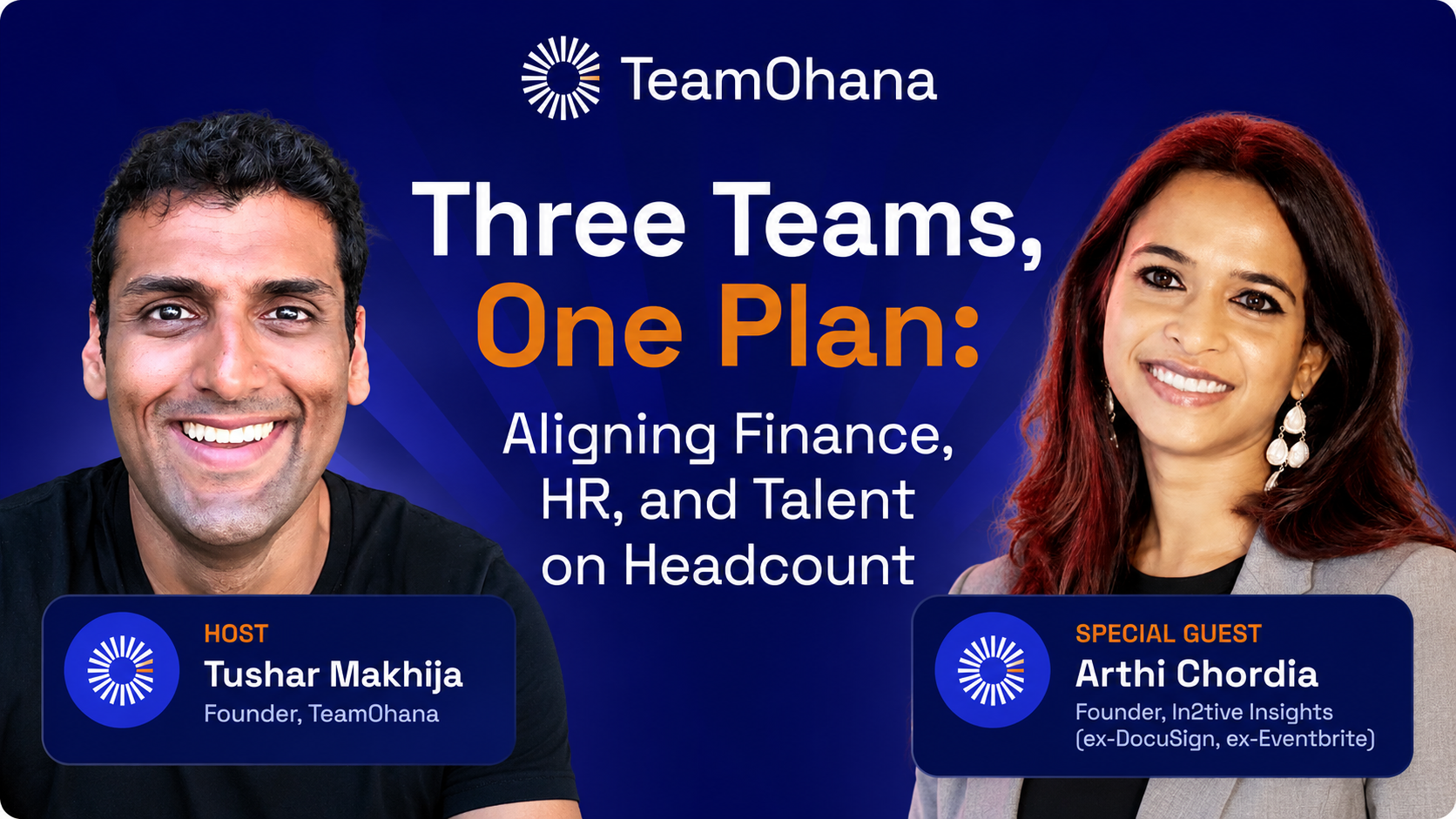
Join Tushar Makhija, Founder and CEO of TeamOhana, for the live unveiling of TeamOhana Computer: a workforce agent built to act, not just answer.
Computer connects to your data sources, runs the analysis, and generates live reports. It completes work that used to take your team a week: reconciling headcount plan against actuals, routing approvals, updating headcount fields, and flagging variances before they cost you. It does this autonomously, in Slack, where your team already works.
The reason a CFO can hand it real work: every action runs inside ABAC governance with a versioned audit trail behind it. Other agents built intelligence you can’t fully trust with workforce data. We built a teammate you can.
This is the move from a tool you ask to a teammate you assign work.
What you’ll see
- The live unveiling and product story from Tushar: what we built, why now, where it’s going
- A working demo of Computer completing real workforce tasks end to end
- Where this fits for Finance, HR, and Talent
- How early access works
Tushar takes questions live throughout. Whether you’re a customer or evaluating TeamOhana for the first time, this is where the next chapter of workforce management gets introduced.
Key Highlights
What You'll Learn
- Why headcount data sitting in ATS, HRIS, and FP&A systems is never a real source of truth, and what to do about it
- How an agentic layer changes who gets access to workforce analysis, and why that matters for execution speed
- What separates a turnkey workforce agent from building your own with Claude Cowork, Codex, or an MCP server
- How to put governance, span of control, budget, and pay bands as guardrails around agentic actions
- Where TeamOhana Computer is live today in closed beta, and what ships at GA in late July
Takeaway 1: The Source-of-Truth Problem Is Still Unsolved
Companies have spent hundreds of millions of dollars on HRIS, ATS, and FP&A systems, and still cannot answer a basic question: how many people do we have, how many are we hiring, and what will it cost. Each system holds a different number. The recruiting lead sees one figure, finance sees another, and HR sees a third. TeamOhana sits upstream of all three and reconciles the data into a single model that humans and agents can both operate on.
Takeaway 2: Without Workflow Context, an Agent Is Just a Chatbot
A generic AI agent can query data. It cannot run the gnarly workflows that actually move workforce planning forward, because it does not know what those workflows are. TeamOhana has encoded four years of operating cadence from companies like Vercel, Vanta, Postman, Greenhouse, and Scale AI directly into the agent. The result is an agent that knows how workforce planning gets done, not just what the data looks like.
Takeaway 3: Access Control Is the Gating Factor for Agentic HR and Finance
Workforce data is sensitive. Comp bands, performance, and scenarios cannot be exposed to every hiring manager or every agent. TeamOhana Computer inherits the same ABAC governance and versioned audit trails that already power the platform, so the agent knows who is asking, what they are allowed to see, and what actions require human approval. This is what makes the system safe for CFO-level deployment.
Takeaway 4: The Real Unlock Is Distributing Decision-Making
Today, most workforce decisions wait on an HRBP, a finance partner, or a data analyst. Business partners are overloaded and tend to support only the most active departments, leaving other hiring managers behind. With TeamOhana Computer, every hiring manager gets a thought partner that reasons inside the company's own guardrails. Decisions happen at the edge, not in a queue.