Key Highlights
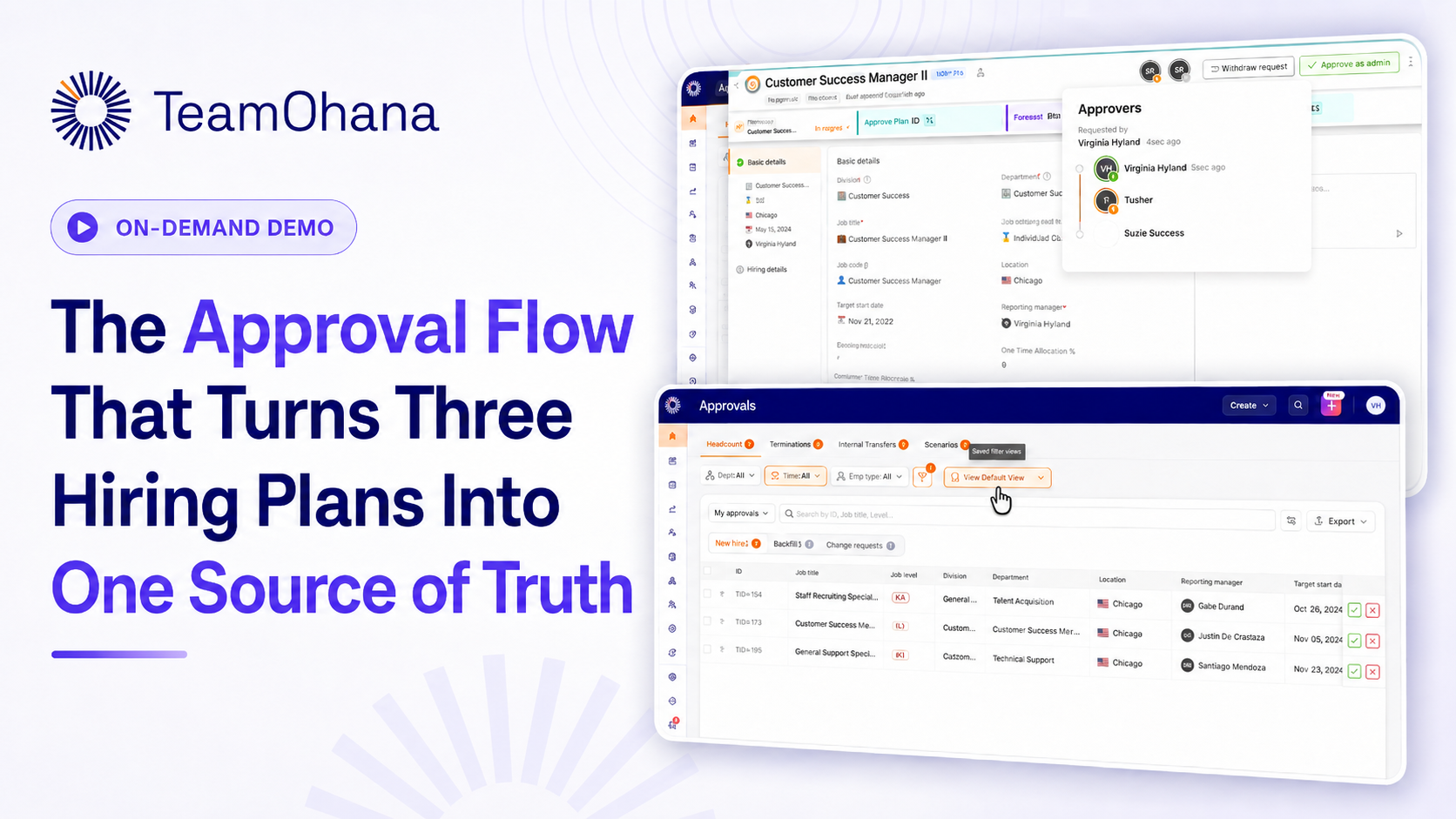
Headcount is the largest line on the P&L and the one Finance has the least real-time control over. The reason is structural. People data lives in the HRIS. Hiring data lives in the ATS. Budget lives in FP&A. The hiring plan lives in a spreadsheet. Getting to one number means exporting from every system and reconciling by hand, which produces a source of truth that's out of date the moment it's finished. This session walks the TeamOhana headcount ledger live and shows what a single source of headcount truth looks like when the reconciliation happens automatically, the forecast math is on screen, and anything that could throw the number off is flagged before it does.
What you’ll learn
- How to consolidate current headcount, starting headcount, new hires, pending starts, terminations, transfers, and open roles into one live view
- How TeamOhana calculates the headcount forecast automatically from HRIS and ATS data
- Why pending starts is the number most finance teams can't see and how to track it
- How the Needs Attention layer catches terminations without a backfill decision and roles past their start date
- How to move from a stale spreadsheet to a reconciled number Finance can push into the FP&A tool
Takeaway #1: The Spreadsheet Is the Problem, Not the Solution
Every headcount reconciliation process ends in a spreadsheet. That spreadsheet has to be updated by hand, has no audit trail, and isn't access controlled. Finance treats it as the source of truth, but it's a snapshot from three systems taken at a moment that's already passed. The reconciliation work isn't a workflow issue. It's a data architecture issue.
Takeaway #2: Pending Starts Is the Blind Spot in Every Forecast
An employee who has accepted an offer but hasn't been set up in the HRIS is invisible to Finance. That gap can last days or weeks. Every forecast built during that window is wrong by exactly that many people. TeamOhana tracks the pending starts population as its own tile, so the forecast reflects reality instead of what the HRIS knew last Friday.
Takeaway #3: A Live Number Is Only Useful If You Can Trust It
Real-time data can still be wrong data. A termination without a backfill decision distorts the forecast. A role past its start date quietly inflates fiscal year cost. The Needs Attention layer surfaces every open question that changes the number and links straight to the record. Finance stops looking at a number that's current and starts looking at a number that's clean.
Takeaway #4: One Source of Truth Means Finance Can Plan Against It
The point of reconciliation isn't a clean spreadsheet. It's a headcount number Finance can push into the FP&A tool with confidence. When every employee group sits in one place, the forecast math is visible on screen, and the integrations refresh automatically, reconciliation stops being a monthly close activity and becomes a running state.
"Instead of exporting from three systems and reconciling into a spreadsheet that's out of date the moment you finished it, every group of employees at your company is in one place. The forecast math is shown on screen, the integrations refresh often, and anything that could throw the number off is flagged for you on the dashboard. That's a single source of headcount truth that you can actually rely on and push into your FP&A tool." — Virginia Hyland, Head of Solutions Engineering, TeamOhana