Key Highlights
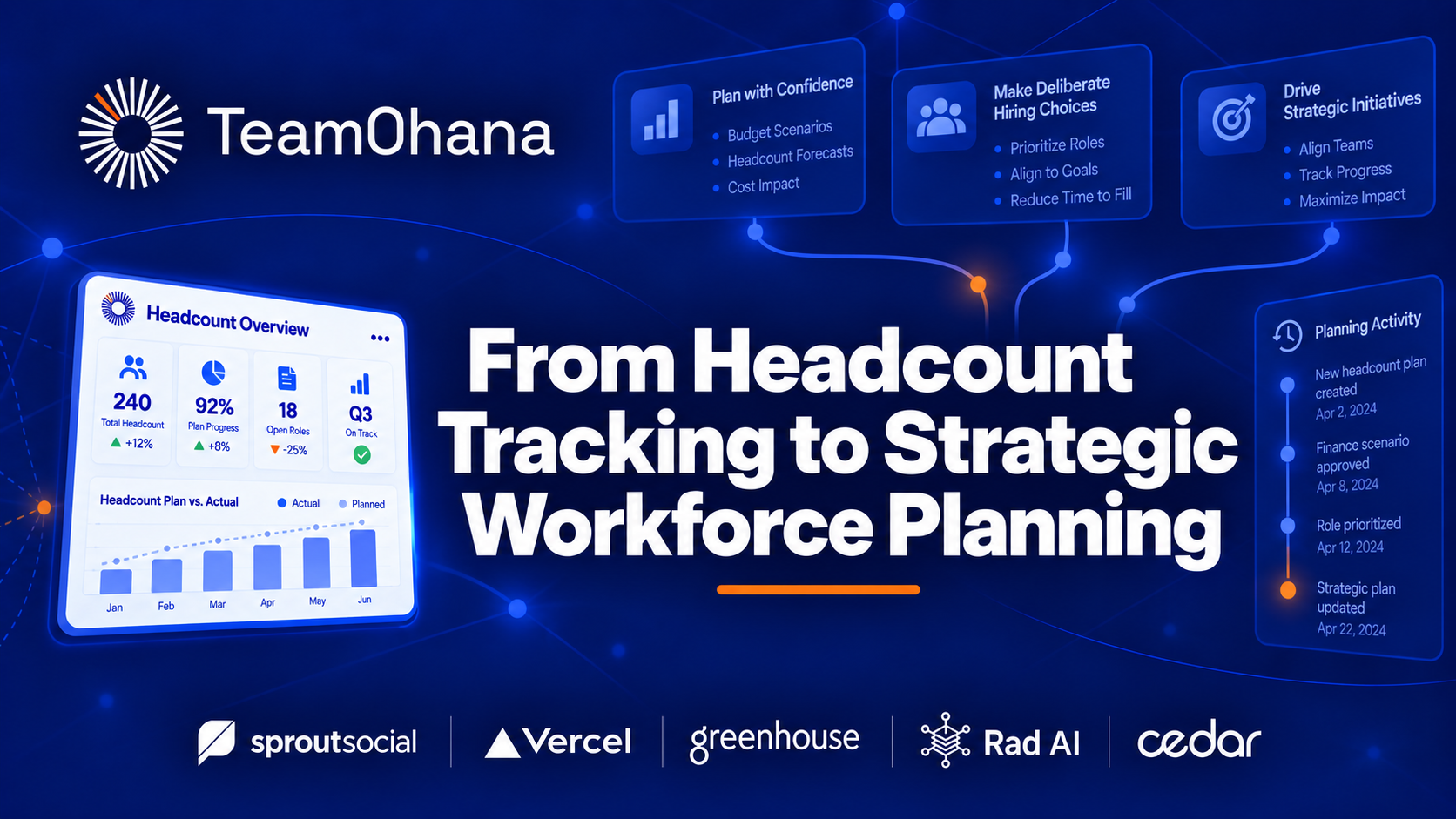
Every finance, HR, and talent team has lived the same weekly ritual: reconcile spreadsheets, chase approvals in Slack, comb through emails to figure out where a role stands. It burns days, produces answers that are already stale, and delays every downstream hiring decision. In this video, five TeamOhana customers, Greenhouse, Vercel, Cedar, Sprout Social, and Rad AI, describe the shift in concrete numbers: 15 hours of reconciliation collapsed to one, two-week approvals down to two days, decision cycles compressed from four weeks to a single day. What changes when the largest line on the P&L stops being reconciled after the fact and starts being governed in real time.
What you’ll hear
- How much time finance, HR, and talent teams are actually losing to weekly reconciliation, and where it goes
- Why approval cycles stall when headcount decisions live in Slack, email, and disconnected spreadsheets
- What "real-time" actually looks like when finance and talent operate from the same headcount source of truth
- How compressing approval turnaround from weeks to days changes hiring velocity and time-to-fill
- What talent leaders do with the hours they get back when they stop pulling reports to answer basic headcount questions
- How five different companies, at different stages and sizes, arrived at the same operational shift
Takeaway #1: Reconciliation is not a task, it is a tax on your largest expense
Headcount is 60 to 80 percent of operating spend, and most companies are paying a hidden tax on it every week: 15 hours at Greenhouse, three to four hours at Cedar, days of Slack archaeology at Vercel and Sprout Social. That time does not just disappear from finance and HR calendars. It delays every hiring decision that depends on knowing the current state of the plan. When reconciliation drops to under an hour, the tax stops.
Takeaway #2: Approval speed is a governance outcome, not a workflow feature
Vercel and Sprout Social both describe the same failure mode: approvals happening in Slack, email, and side conversations, taking two to four weeks to close. The fix is not a faster chat tool. It is moving the approval into the same system that holds the budget, the plan, and the req, so the decision has full context the moment it is made. That is why approval time collapses from weeks to days.
Takeaway #3: Real-time visibility replaces the report-pulling economy
Will at Rad AI names it directly: every talent leader has answered the fire-drill Slack. The old answer was a report. The new answer is a two-second lookup. When the underlying data is governed and unified, reporting stops being a job and becomes a byproduct. That reclaims capacity for the work talent leaders were actually hired to do.
Takeaway #4: The pattern holds across companies, stages, and industries
Five customers. Different sizes, different sectors, same shift. That consistency matters: it says the reconciliation problem is not specific to a stage or an industry, it is structural. Any company running headcount across HRIS, ATS, and a finance spreadsheet will hit it. And the resolution looks the same regardless of where you start.
"Every talent leader out there has had the fire drill Slack message that, 'Hey, what's going on with this?' I just click over to a tab and I have the answer in two seconds. I never have to pull a report." — Will Barnett, Director of Talent, Rad AI