Key Highlights
Annual headcount planning consumes weeks of finance time and still produces a plan that's out of date the moment it's approved. Twenty-five spreadsheets go out, come back inconsistent, get consolidated by hand, and then break the first time a level changes or a role gets re-scoped. The result is variance finance can't explain and a hiring plan the business doesn't trust.
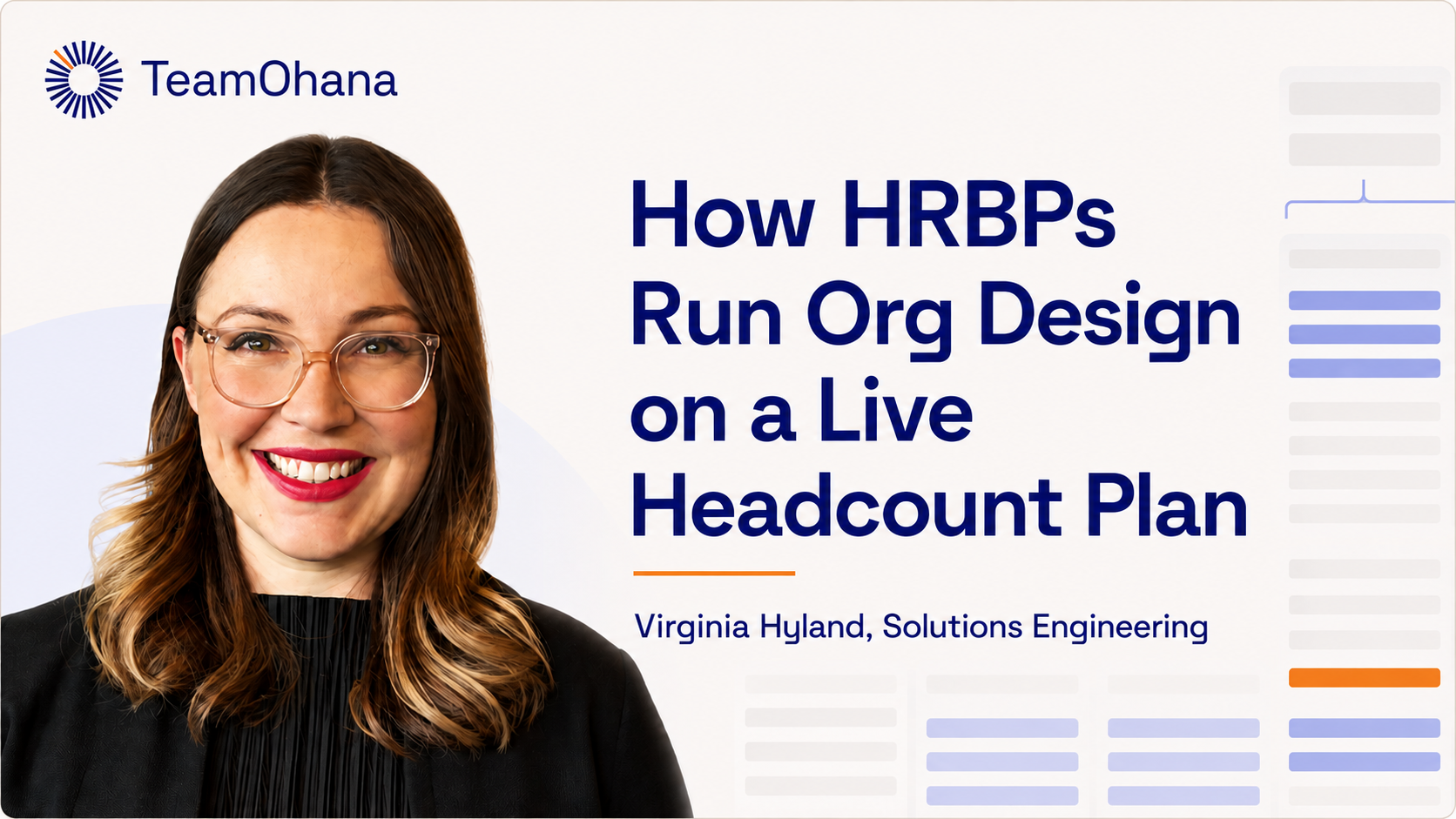
This session walks through how TeamOhana replaces that process with a single collaborative planning scenario. Finance sets the top-down envelope. Business leaders build bottoms-up inside their own scope. Every change is priced against the job catalog in real time, tracked in a change log, and locked through an approval workflow that turns the plan into an executable hiring plan the day it's approved.
What you’ll learn
- How to run annual planning as one live scenario instead of a spreadsheet consolidation cycle
- How to set a top-down not-to-exceed budget in dollars and heads without blocking bottoms-up input
- How to give each business leader scoped access to only their departments and their budget
- How to price every new headcount against your job catalog automatically, including level, location, and target start date
- How to handle placeholder headcount when a leader knows they need a role but not the exact level yet
- How to switch between fiscal-year cost and annualized run-rate views to pressure-test the plan
- How to review every change in one log and approve the plan through a Slack and email workflow
- How to merge the approved plan live so it becomes the executable hiring plan, not a static document
Takeaway #1: The Spreadsheet Process Is the Source of the Variance
The reason annual planning produces variance isn't that finance lacks a tool. It's that the process itself introduces error at every handoff. Twenty-five spreadsheets, manual consolidation, and stale role data mean the plan is wrong before it's approved. Fix the process and the variance shrinks with it.
Takeaway #2: Bottoms-Up Planning Only Works With Real-Time Cost Feedback
Business leaders can't build a realistic plan if they only see the financial impact after finance rolls it up. Connecting every headcount to the job catalog means the leader adding the role sees the cost, the variance, and the guideline draw-down as they build. Governance moves upstream, into the decision itself.
Takeaway #3: Fiscal Year Cost and Annualized Run Rate Are Two Different Decisions
Target start dates matter for this year's P&L. Annualized run rate matters for next year's baseline. Planning in only one view hides the other. TeamOhana lets leaders toggle between both, so a decision to push three start dates by 90 days shows up as lower fiscal-year cost and unchanged run rate, exactly the tradeoff finance needs to see.
Takeaway #4: Approval Is Where the Plan Becomes Executable
A signed spreadsheet is not an executable plan. It's a document. The approval workflow in TeamOhana reviews every tracked change, routes it through the right approvers over Slack and email, and then merges the approved headcount live. From that moment forward, recruiting and finance are working from the same plan, and every hire draws down the same budget.
"Annual planning doesn't fail because finance lacks data. It fails because the plan is built in twenty-five spreadsheets, consolidated by hand, and out of date the moment it's approved. The fix is one live scenario where every decision is priced, tracked, and authorized in the same place." — Virginia Hyland, Head of Solutions Engineering, TeamOhana