

.svg)
Curious how TeamOhana can help you? Talk to us.
In this article
Never miss new content
If you ask most Finance or HR leaders how confident they are in their workforce data, they'll tell you they're on top of it. Then you ask them how long it takes to pull a reliable answer about recruiter throughput or where their engineering headcount costs are actually concentrated and the answer gets complicated fast. The data exists. But getting to it usually means waiting on an analyst or wrestling with a dashboard that wasn't built for the question you're actually asking.
This is the gap that Teemo, TeamOhana's AI workforce analyst, closes. Teemo sits on top of TeamOhana's normalized, access-controlled workforce data and lets Finance, HR, and Talent teams ask questions in plain language and get real-time answers. The result is a fundamentally faster way to turn workforce data into decisions.
But now we’ve taken it a step further.
TeamOhana's new Recipes feature gives teams a library of pre-built analyses designed around the questions and reports our customers come back to most. Instead of starting from scratch, you're starting from the answer. Here, we’ll walk through what Recipes are, how they work, and what they look like in practice.
Note: Teemo Recipes are available in TeamOhana as of April 10, 2026.
What are Teemo Recipes?
Recipes are pre-built workforce analyses built directly into Teemo. Each Recipe is a fixed, expert-designed prompt that runs on your live TeamOhana data and returns the same structured output every time you run it — a summary, a data table, and a visualization.
TeamOhana built the initial Recipe library by going directly to customers and asking a simple question: what are the analyses you run on a regular cadence, and what do your leaders actually need to see? The result is a set of analyses covering the workforce questions Finance, HR, and Talent teams care about most, organized by persona so the right people see the right data.
Out of the box, Recipes give you:
- Consistent outputs. The same Recipe run today and run next quarter returns the same structure, making it easy to track trends over time.
- Role-based results. Teemo respects TeamOhana's access controls, so the same Recipe returns different data depending on who runs it. A division leader sees their team. A CFO sees the whole company.
- Shareable analyses. Admins can push specific Recipes to leaders and teams so that when they log in, they see exactly what's relevant to them — nothing more, nothing less.
- A starting point for deeper questions. Every Recipe output feeds directly into Teemo, so you can ask follow-up questions on top of the results and dig deeper without starting over.
TeamOhana manages the data normalization and access control layer that makes all of this possible. Teemo operates on top of that foundation, which means every answer you get is drawn from clean, reconciled data — not a spreadsheet someone updated last Tuesday.
3 Teemo Recipes for making smarter workforce decisions today
Teemo launched with Recipes spanning Finance, HR, and Talent use cases — from budget variance analysis to recruiter throughput to org structure forecasting.
1. Department Tenure Mix
Understanding the experience level of your workforce sounds simple — until you try to pull that data across every department in a single, reliable view. The Department Tenure Mix recipe does that automatically.
It groups your employees into tenure buckets by department and surfaces where your most experienced teams are concentrated, where institutional knowledge may be at risk, and where you have a high proportion of newer employees who may still be building context.

When you run this Recipe, Teemo generates a department-by-department breakdown across four tenure buckets: zero to one year, one to two years, two to four years, and four or more years.
Each row shows the distribution for a single department, and a summary row at the bottom gives you the company-wide average as a benchmark. You can toggle between a percentage view and a raw headcount view depending on what you need.
The AI summary that accompanies the output calls out the most significant patterns — departments with a disproportionately new workforce, teams where institutional knowledge is heavily concentrated, and how individual departments compare to the organizational average.

For HR leaders, this analysis is useful for identifying departments where recent hiring has produced a predominantly early-tenure workforce, spotting where critical institutional knowledge is concentrated, and informing decisions around mentorship, career development, and succession planning. It turns a question that would otherwise require a custom data pull into something you can answer in seconds.
2. Recruiter Throughput
When hiring is moving slowly, the instinct is often to assume the problem is in the candidate pipeline. But the bottleneck is just as likely to be internal — roles sitting unworked, workloads distributed unevenly across the recruiting team, or a handful of recruiters carrying a disproportionate share of the active pipeline.
The Recruiter Throughput recipe gives Talent leaders a clear view of exactly where things stand.

This Recipe pulls data directly from your ATS and measures four things for each recruiter on your team:
- Total roles assigned
- How many have been closed,
- How many are actively in progress
- How many haven't been started yet
From there, it calculates closure rate and active load percentage so you can see not just how much each recruiter is carrying, but how efficiently they're moving work through the pipeline.

The AI summary surfaces the patterns that matter — recruiters with heavy active pipelines but lower closure rates, those moving work through efficiently, and where unstarted roles are piling up without proportional output. Because Teemo is connected directly to your ATS, you can also use the output as a jumping-off point for follow-up questions, drilling into a specific recruiter's pipeline or comparing performance across a time period without leaving the platform.
For Talent leaders managing hiring targets across multiple divisions, this Recipe replaces a time-consuming manual reconciliation with a real-time view that's ready the moment you need it.
3. Global Footprint
For companies with employees across multiple countries, understanding where your workforce is concentrated is only half the picture. The more important question is whether your compensation exposure follows the same pattern — and the answer is often surprising.
The Global Footprint recipe gives Finance and HR leaders both views side by side.
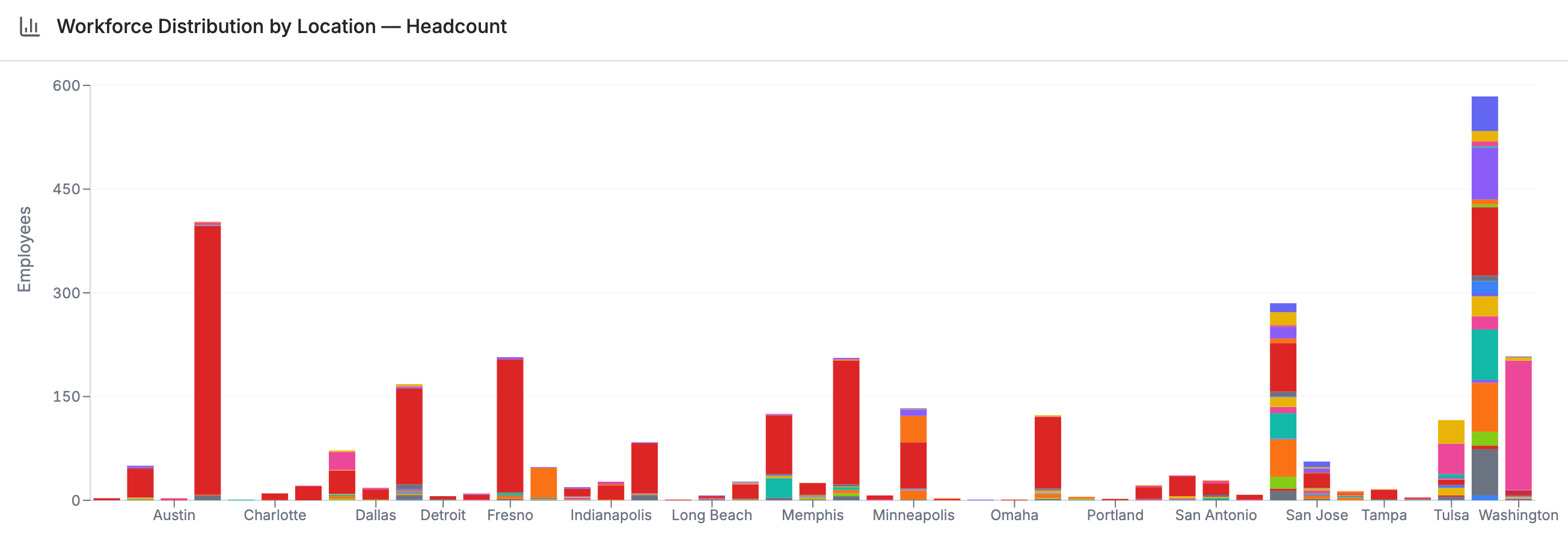
This Recipe displays your workforce distribution by country, broken down by department, with a toggle between headcount and compensation cost views.
The headcount view shows you where your employees are. The cost view shows you where your spend is.
Comparing the two reveals something that's easy to miss when you're looking at either view in isolation — the countries carrying the most headcount aren't always the countries carrying the most cost.

The AI summary pulls out the most significant divergences between the two views. In a company with a large engineering presence in India, for example, India might represent the majority of global Engineering headcount while the United States carries a disproportionately higher share of Engineering compensation spend.
That kind of structural insight has real implications for how Finance teams think about geographic hiring strategy and cost optimization.
For leaders making decisions about where to grow next, Global Footprint turns a question that would typically require a custom report into something you can answer — and act on — in real time.
Establish your foundation for workforce intelligence
Department Tenure Mix, Recruiter Throughput, and Global Footprint are just three examples of what Finance, HR, and Talent teams can do with Teemo Recipes. But there are so many more available to use right now, including:
- Org structure forecast: Projects end-of-year headcount and compensation costs by job level based on current hiring plans
- Span forecast: Projects future span of control by division and role once confirmed hires and approved headcount are filled
- Span exceptions: Identifies managers and divisions with spans of control outside healthy benchmark ranges, both today and forecasted
- Hiring velocity: Measures hiring process speed across divisions using rolling 12-month averages to surface where delays are originating
- Start date drift: Identifies roles where planned start dates have shifted and analyzes the patterns behind those changes
- Recruiter throughput: Analyzes recruiter workload distribution, pipeline status, and closure velocity across assigned headcounts
- Stalled roles: Surfaces open roles with the least recent pipeline activity so you can spot bottlenecks before they impact hiring timelines
- Division budget variance: Identifies divisions where projected hiring spend exceeds allocated budget and quantifies the expected variance
- Hiring slippage: Identifies roles budgeted for the current quarter that have shifted to a later quarter and quantifies the financial timing impact
- Attrition watch: Displays rolling 12-month attrition rates by division to highlight workforce stability trends and accelerating exit risk
But the reason Recipes work so well is less about the prompt and more about the data structure underneath it all.
TeamOhana is the governance layer for workforce decisions. It's where your headcount plans, requisitions, approvals, budgets, and org data are structured, connected, and permissioned in one place — so that when Teemo runs a Recipe, it's running it on data you can actually trust.
If you're ready to see what that looks like for your organization, get a demo of TeamOhana and the Teemo workforce analyst.
Take control of your headcount spend

Teemo Recipes FAQs
Simplifying TeamOhana: your questions, answered.
Teemo Recipes are pre-configured workforce analyses built directly into Teemo that run on your live TeamOhana data and return the same structured output every time. Each Recipe is designed around the reports and analyses Finance, HR, and Talent teams come back to most, so instead of starting from scratch, you're starting from the answer.
The initial Recipes launch includes analyses spanning Finance, HR, and Talent use cases. Analyses include org structure forecasting, span of control, global workforce distribution, hiring velocity, recruiter throughput, start date drift, budget variance, hiring slippage, and attrition. Additional Recipes are in development and will be released in subsequent updates.
A standard LLM gives you different outputs depending on how a question is phrased, who's asking it, and what data has been provided. Teemo Recipes are fixed prompts that run on TeamOhana's normalized, reconciled workforce data and return consistent, structured results every time — so you're not managing prompt variability or questioning whether the underlying data is clean.
Teemo Recipes respect TeamOhana's existing role-based access controls, which means the same Recipe returns different data depending on what each user is authorized to see. Admins can share specific Recipes with leaders and teams across the organization, ensuring every user sees the analyses that are relevant to them without accessing data outside their permissions.
.png)